Beyond Borders: Investigating Bronze Age (2200–1500 BC) Connections Between the Czech Lands and Western Hungary — Part 1
Supported by the bilateral international research mobility grant awarded in 2023 jointly to the HUN-REN Research Centre for the Humanities, Institute of Archaeology, and the Institute of Archaeology in Prague, Czech Academy of Sciences, we are examining cultural connections between Western Hungary and Central Bohemia during the period 2200–1500 BC. The Hungarian team includes Viktória Kiss (principal investigator), Eszter Melis, and Nóra Szabó, while the Czech participants are Daniel Hlásek (principal investigator), Michaela Langová, and Michal Ernée.
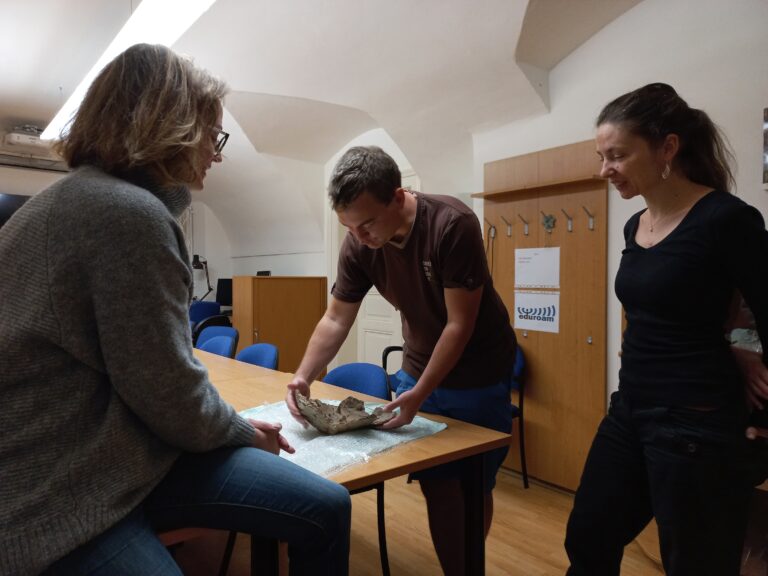
Nóra Szabó, Michaela Langová and Daniel Hlásek examining a fermenting vessel at the Institute of Archaeology, Prague (Czech Academy of Sciences)
The period under investigation corresponds to the Early Bronze Age and its transition to the Middle Bronze Age in Hungary. Both regions maintained close links to Alpine and Slovak raw material sources, as well as to the River Danube, which served as a key communication route. Apart from the occasional mention of imported artefacts, no targeted research has so far focused on the interaction networks between the two regions.
Material culture plays a central role in exploring these interactions: stylistic and technological analysis of archaeological finds can help identify imported objects, local imitations, and hybridisation processes resulting from the combination of stylistic elements.
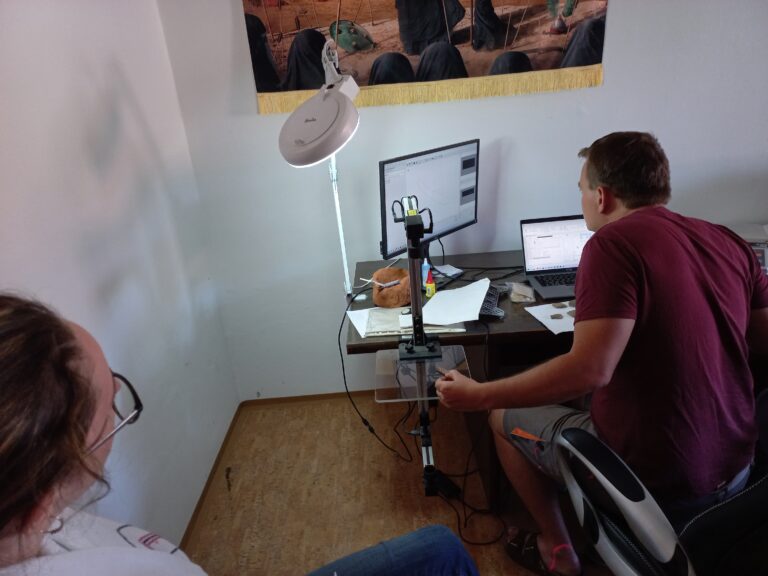
Documenting a presumed Tokod-type imported jug using a Laser Aided Profiler (https://www.laseraidedprofiler.com/)
As part of the mobility project, Eszter Melis and Nóra Szabó spent seven days in the Czech Republic between 12–18 May 2024. During their stay, they examined several potential imported artefacts known from the archaeological literature and compared them with locally produced objects of similar date. They studied Bronze Age materials (mainly pottery vessels and sherds dating to 2200–1500 BC) both at the Institute of Archaeology in Prague and in several regional museum collections and storerooms (Netolice, Závist, České Budějovice), where they discussed stylistic, material and technological features with Czech colleagues.
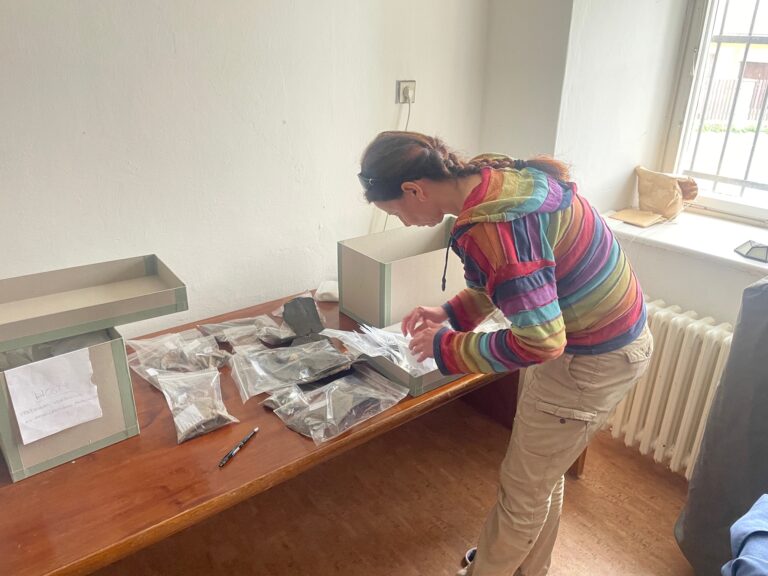
Eszter Melis packing ceramic finds in the Netolice storage facility of the South Bohemian Museum
In addition, the researchers visited the key site of Hosty, which plays a central role in understanding connections with the Carpathian Basin, and had the opportunity to explore the modern archaeological exhibition at the South Bohemian Museum (Jihočeské Muzeum) in České Budějovice
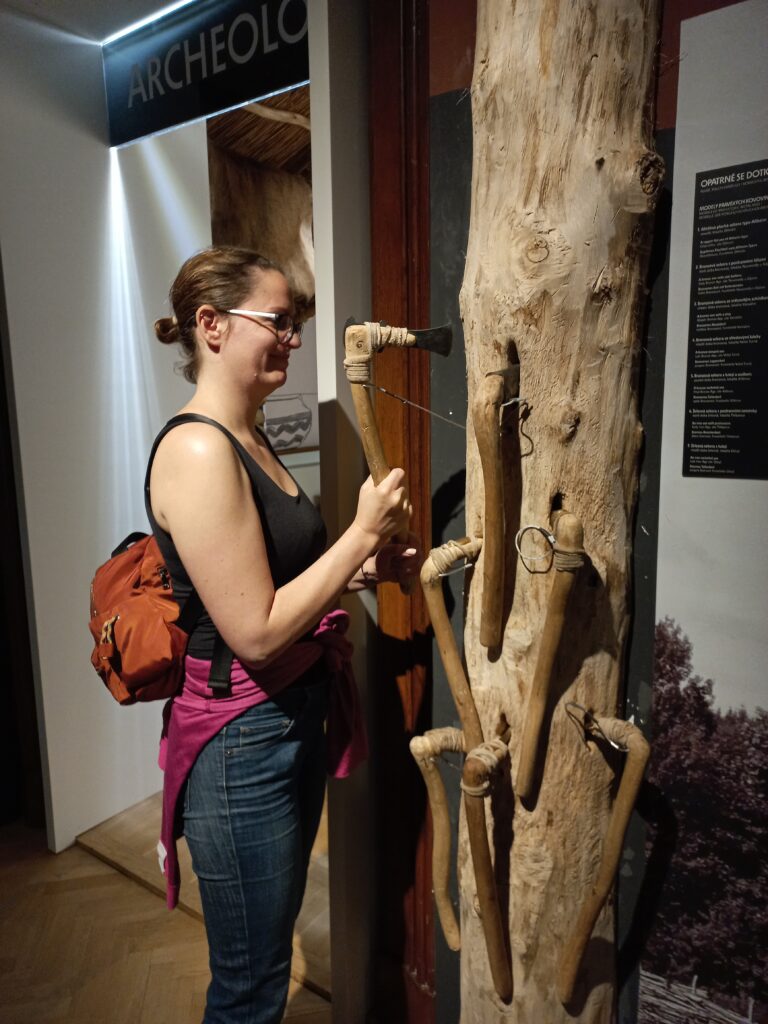
Nóra Szabó with replicas of Bronze Age axes in the exhibition of the South Bohemian Museum (Jihočeské Muzeum)
The visit proved extremely valuable not only for gaining deeper insight into the archaeological material and for professional exchanges with colleagues abroad, but also for strengthening international cooperation. Informal discussions with Czech Bronze Age specialists—including Ondřej Chvojka, Ondřej Švejcar and Lucie Velová—provided an excellent opportunity to share recent research results.
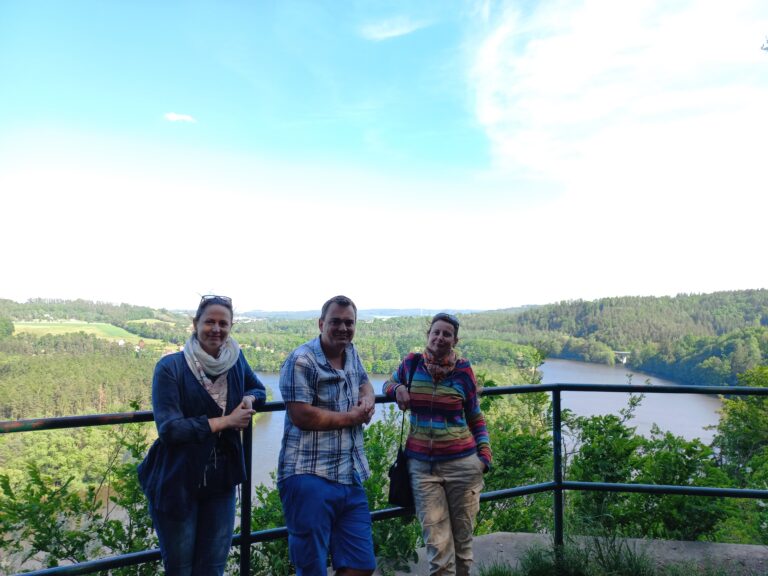
Nóra Szabó, Daniel Hlásek and Eszter Melis at the site of Hosty
Overall, the visit marks a promising start to the bilateral mobility project, and we look forward to welcoming our Czech colleagues to Hungary this autumn.
Eszter Melis – Nóra Szabó