Research on Bronze Age Amber Finds in Hungary – A New Study from Polish–Hungarian Collaboration
A new study presenting the most recent analyses of Bronze Age amber finds from Hungary has been published in volume 75/2 (2023) of the prestigious Polish journal Sprawozdania Archeologiczne. The research began in 2016 as a collaboration between Mateusz Jaeger (Adam Mickiewicz University, Poznań; European Culture) and the Institute of Archaeology of the Research Centre for the Humanities (MTA BTK), supported by the National Science Centre of Poland (Narodowe Centrum Nauki). The project set out to examine Bronze Age amber finds from Hungary that had not previously been analysed, using infrared spectrometric investigations conducted in the Department of Chemistry at Adam Mickiewicz University. Alongside determining the provenance of the Hungarian amber artefacts, the archaeological and chemical analyses also aimed to refine their chronological classification through radiocarbon dating and to produce a comprehensive assessment of the assemblages. Numerous Hungarian museums contributed to the project, including the Hungarian National Museum, the Budapest History Museum, the Damjanich János Museum (Szolnok), the Ferenczy Museum Centre (Szentendre), the Forgách–Lipthay Castle Museum (Szécsény), the Sopron Museum, and the Türr István Museum (Baja), all of which hold Bronze Age grave finds containing the jewellery examined.
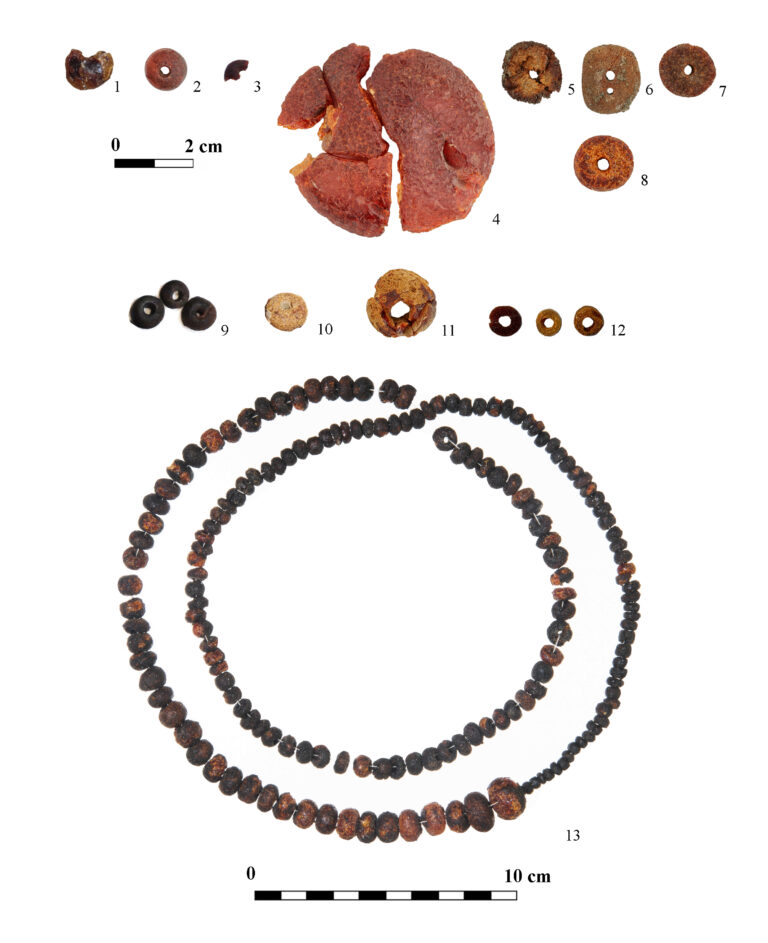
Amber beads from the following sites: 1. Füzesabony–Öregdomb, 2. Hegyeshalom–Újlakótelep, 3. Hernádkak–Cemetery, 4–8. Jánoshida–Berek, 9. Kötegyán–Sarkadi Road (Gyepespart), 10. Megyaszó, 11. Nagycenk–Lapos-rét, 12. Szurdokpüspöki–Hosszú-dűlő, 13. Jászdózsa–Kápolnahalom (Photo: Péter Hámori).
A Kárpát-medence bronzkori időszakában (Kr. e. 2600 és 800 között) a bronz és arany ékszerek mellett kiemelkedő státuszt és presztízst jelző tárgyak voltak a megkövesedett fenyőgyantából készített borostyán ékszerek. A ritka nyersanyag Európa területén csupán néhány helyen fordul elő, legismertebb a Balti-tenger partvidéke. A mai Magyarország bronzkori sírjaiban, kincsleleteiben és ritkán településeken is megtalálhatók az apró borostyán gyöngyökből álló nyakláncok, olykor bronzdíszekkel kombinálva, arany ékszerek kíséretében.
During the Bronze Age in the Carpathian Basin (c. 2600–800 BCE), amber ornaments made of fossilised pine resin ranked among the major status and prestige items, alongside bronze and gold jewellery. The raw material is rare and occurs naturally in only a few parts of Europe, the best-known being the south-eastern shores of the Baltic Sea. In the territory of present-day Hungary, small amber-bead necklaces—sometimes combined with bronze ornaments and accompanied by gold jewellery—are found in Bronze Age graves, hoards, and, more rarely, on settlements.
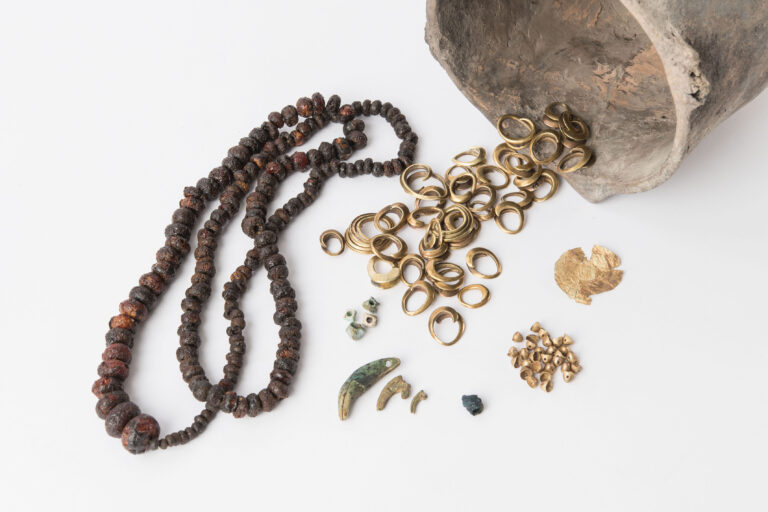
Treasure find from the Middle Bronze Age settlement at Jászdózsa–Kápolnahalom (Photo: Péter Makrai, Damjanich János Museum).
Raw-material analyses conducted since the 1960s have demonstrated that the vast majority of European amber finds originate from the Baltic region (Baltic amber or succinite), which reached Central and South-Eastern Europe along river-valley trade routes, much like bronze. Analyses previously undertaken on amber jewellery discovered in present-day Hungary have likewise confirmed the exchange of Baltic succinite. In the wider Carpathian Basin, however, other resins resembling amber are known, such as the ajkaite found near Veszprém and rumenite in Romania; this raised the question of whether Baltic amber might occasionally have been substituted with these local variants.
The newly published study brings together data from 52 Bronze Age sites, including six for which new radiocarbon dates provide a more precise understanding of amber exchange networks. The amber items analysed from all twelve Early, Middle and Late Bronze Age sites presented in the article proved to be of Baltic origin. The study of these prestige objects—brought into the Carpathian Basin through long-distance trade—is of outstanding importance for reconstructing the exchange networks of Bronze Age societies in Central Europe.
https://mobilitas.ri.abtk.hu/?media=kulonleges-bronzkori-lelohelyek-uj-egyuttmukodesek-paratlanul-gazdag-noi-temetkezes-baja-kornyekerol&lang=hu
The study:
Mateusz Jaeger, Gabriella Kulcsár, Eszter Melis, Mateusz Stróżyk, Paweł Piszora, Marietta Csányi, Réka Csuvár-Andrási, Klára P. Fischl, Szilvia Guba, Evelin Pap, Emília Pásztor, Róbert Patay, Ildikó Szathmári, Gábor Szilas, Agnė Čivilytė, Viktória Kiss: BALTIC AMBER IN THE HUNGARIAN BRONZE AGE. NEW DATA AND CURRENT STAGE OF RESEARCH. Sprawozdania archeologiczne 75/2 (2023) 137–186. https://doi.org/10.23858/SA/75.2023.2.3500
Kiss Viktória