New Study on the Middle Bronze Age Settlement Network of North-Western Transdanubia Published in Antaeus 39
The institute’s periodical, Antaeus, published by the HUN-REN Institute of Archaeology of the Research Centre for the Humanities, presents new results in archaeology and its related disciplines in English, accompanied by summaries in German. In the newly released volume edited by Csilla Zatykó, seven studies explore the changing dimensions of human settlement from prehistory to the early modern period. The complete volume is also available online on the Institute’s website.
The 39th volume of Antaeus (From the website of the Institute of Archaeology, HUN-REN RCH)
The current issue features studies that examine the spatial and environmental aspects of human habitation from the Early Bronze Age through to the Ottoman period. The spatial scale of the analyses ranges from the internal layout of individual sites to broad regional perspectives, and interdisciplinary approaches, along with the integrated application of state-of-the-art GIS technologies, characterise the research presented. The topics covered are diverse, focusing on settlement dynamics, patterns of landscape use, characteristics of crop cultivation, the mapping of activity zones, and the social significance of spatial boundaries.
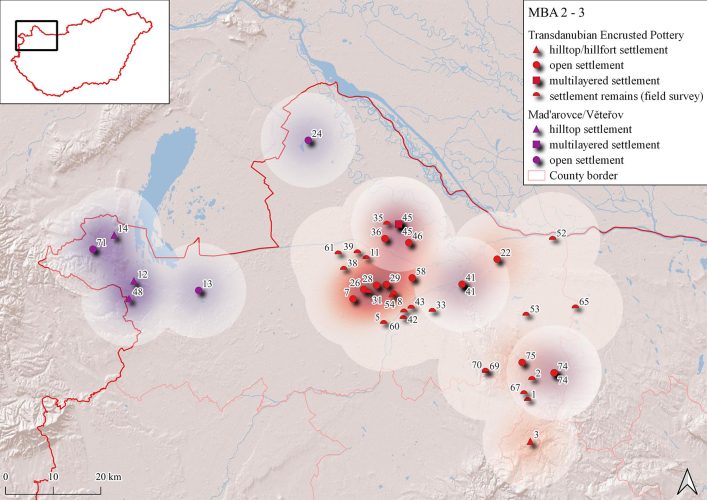
Kernel Density Estimation of settlements with different material Cultures in the Middle Bronze Age in Győr-Moson-Sopron County
The volume includes a new study by our colleague Eszter Melis, which analyses the settlement network during the transition between the Early and Late Bronze Age in the region of North-Western Hungary. Situated at a key crossroads of several Bronze Age cultural groups, the region offers a crucial case study. One of the aims of the paper is to distinguish settlement zones associated with different material-cultural groups and to examine how these relate to environmental conditions. In addition, the study investigates differences in the location and structure of settlements, as well as temporal changes in settlement types. It also attempts to integrate data from this previously less-researched area into the broader settlement history of the Middle Bronze Age in Transdanubia.
Eszter Melis – Csilla Zatykó