Beyond Borders: From Moravia to the Elbe Catchment Area – Part 3
In 2023, the HUN-REN RCH Institute of Archaeology and the Archaeological Institute of the Czech Academy of Sciences in Prague were awarded bilateral international research mobility funding. The grant supports the study of connections between Western Hungary and Central Czech region during the period between 2200 and 1500 BCE. Within the framework of the ongoing project led by Viktória Kiss and Daniel Hlásek, which we have introduced in previous posts, we conducted a six-day research visit to the Czech Republic in May 2025.
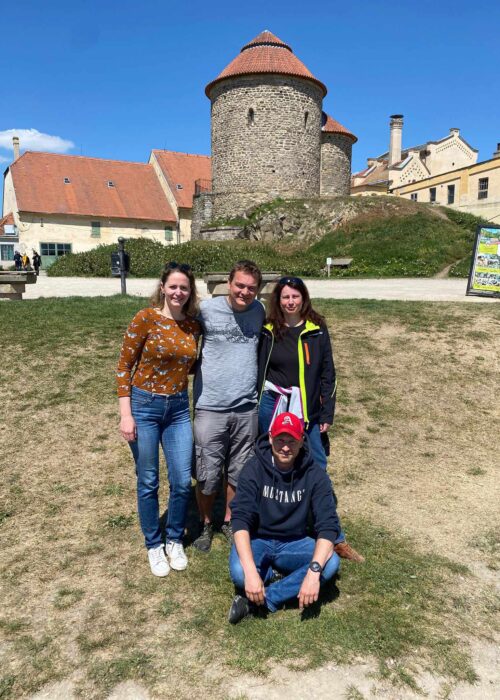
In front of the medieval rotunda in Znojmo (from left to right: Nóra Szabó, Daniel Hlásek, Eszter Melis, and David Rožnovský) (Photo: Petr Eckl)
One of the main objectives of the current trip was to visit museums in Moravia, a key connecting region between Central Czechia and Western Hungary, and to study the Bronze Age collections held there. Milan Salaš guided us through the exhibition and archaeological storage at the Brno museum, while David Rožnovský accompanied us at the museum in Znojmo. In addition, we visited the recent archaeological exhibition in Roztoky near Prague, which presents one of the largest Early Bronze Age hoards from the Czech Republic, discovered at Tursko.
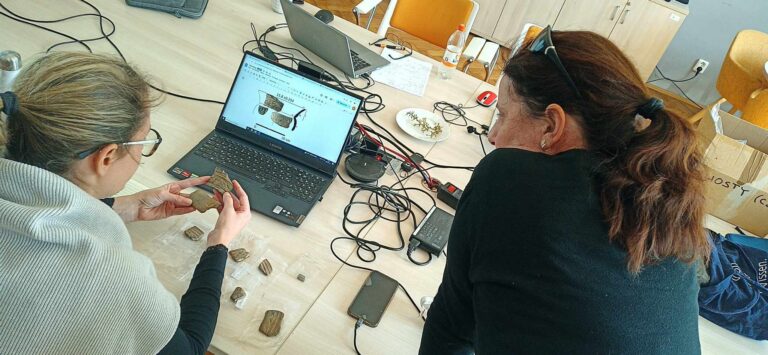
Documentation of a ceramic vessel (Photo: Daniel Hlásek)
During this visit, in addition to examining and documenting archaeological finds, we reviewed the database of related Bronze Age objects from both the Czech Republic and Western Hungary and discussed plans for upcoming international presentations and a joint publication.
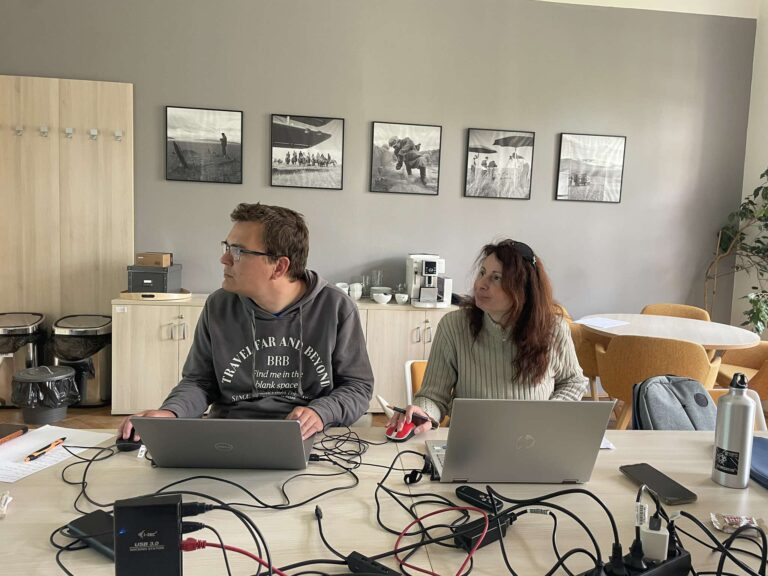
Collaborative work (Photo: Nóra Szabó)
As part of a pleasant excursion near Prague, we visited the core area of the Early Bronze Age Únětice (Aunjetitz) culture, one of the first Bronze Age culture in Central Europe. The burial site that gave the culture its name and the Prague-Suchdol site—primarily known for its contemporary hoard famous by its daggers—is connected by a marked hiking trail, from several points of which we could enjoy panoramic views of the landscape, which had already been settled in the Bronze Age.
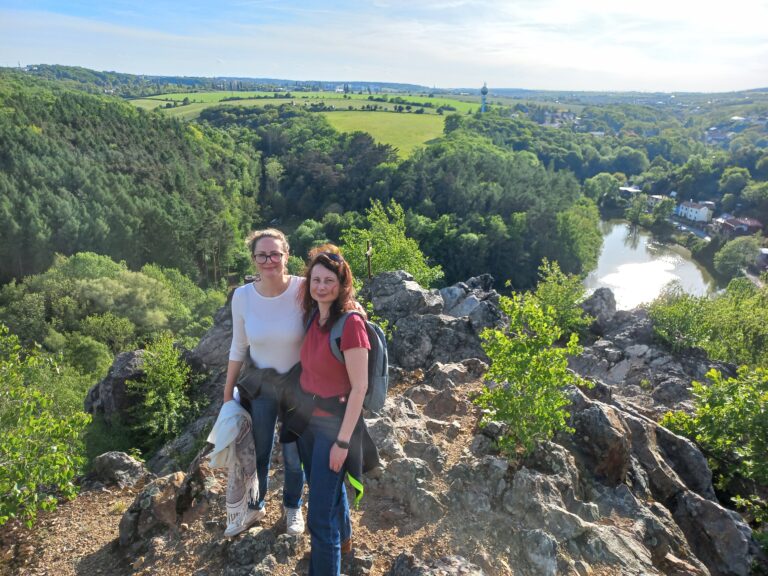
On the hill above the Únětice stream (Photo: Daniel Hlásek)
Eszter Melis