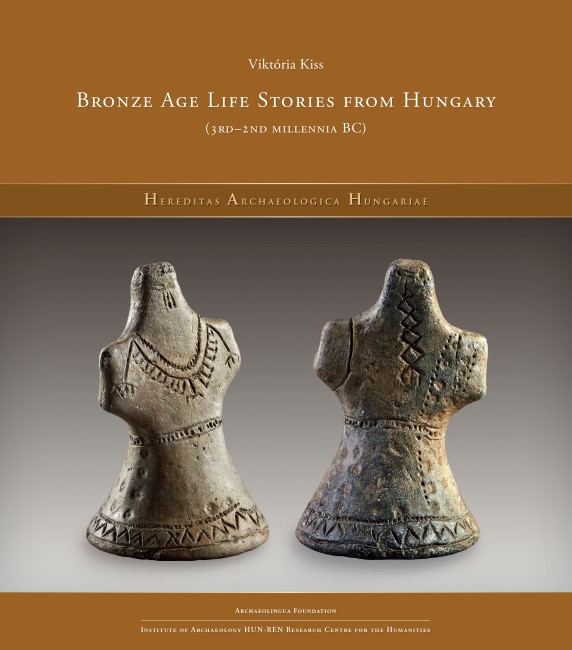
Review of the book Bronze Age Life Stories in Hungary
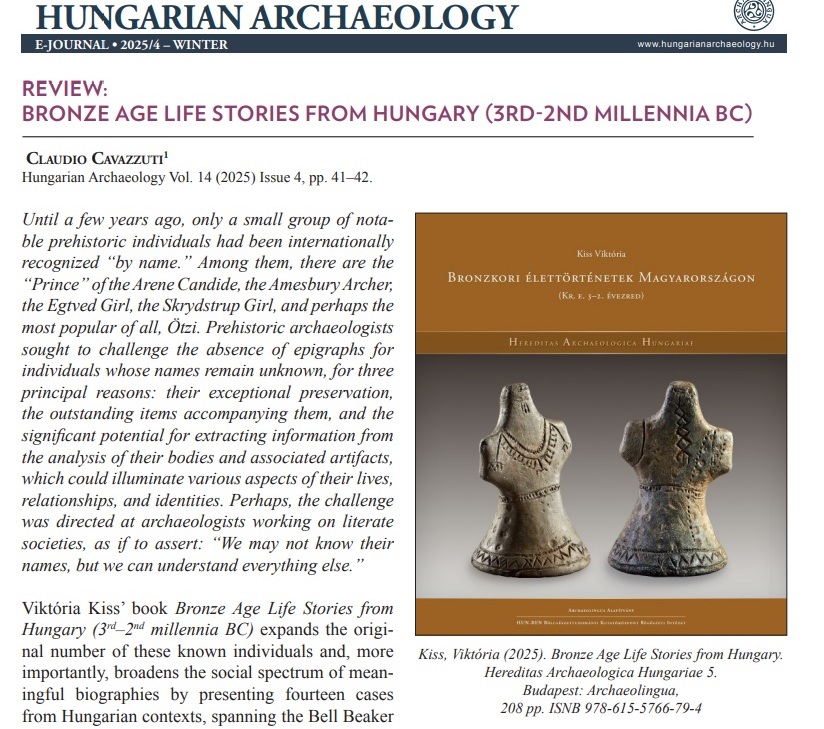
The review highlights the importance of bioarchaeological case studies from the prehistoric period preceding written sources:
“Until a few years ago, only a small group of notable prehistoric individuals had been internationally recognized ’by name’. Among them, there are the ’Prince’ of the Arene Candide, the Amesbury Archer, the Egtved Girl, the Skrydstrup Girl, and perhaps the most popular of all, Ötzi. Prehistoric archaeologists sought to challenge the absence of epigraphs for individuals whose names remain unknown, for three principal reasons: their exceptional preservation,the outstanding items accompanying them, and the significant potential for extracting information from the analysis of their bodies and associated artifacts, which could illuminate various aspects of their lives, relationships, and identities. Perhaps, the challenge was directed at archaeologists working on literate societies, as if to assert: “We may not know their names, but we can understand everything else.” Viktória Kiss’ book Bronze Age Life Stories from Hungary (3rd–2nd millennia BC) expands the original number of these known individuals and, more importantly, broadens the social spectrum of meaningful biographies by presenting fourteen cases from Hungarian contexts, spanning the Bell Beaker period to the Late Bronze Age. (…) It is precisely this focus on individual biographies, as exemplified by Kiss’ volume, that holds the potential to enrich our understanding of the Bronze Age. This work not only serves to engage the scientific community but also has the potential to resonate with a broader audience, inviting greater public interest in prehistoric archaeology.”