Web databases, data analysis and modelling in archaeological research
Viktória Kiss and Gabriella Kulcsár’s study published in the Hungarian Archaeology journal in 2025 deals with the storage, structuring, modelling, interpretation, and publication of large, complex research data sets (big data), one of the greatest scientific and social challenges of the 21st century. Similar to other disciplines, archaeological research has also been confronted with the dilemma of how to handle the exponential growth and expansion of data, thanks to much more intensive cooperation with the life and natural sciences over the past two decades. This is reflected in the fact that, following the birth of archaeology at the end of the 19th century and the “radiocarbon revolution” that defined the second half of the 20th century, international research refers to our current era as the Third Science Revolution, in connection with the enormous amount of data awaiting interpretation and the impact of new methods on archaeological research (Kristiansen 2014; Kristiansen 2025). In our article, we review some international trends and related domestic initiatives, without claiming to be exhaustive. The latter include the databases created by the MTA–ELTE HTK Lendület “Momentum” BASES Research Group.
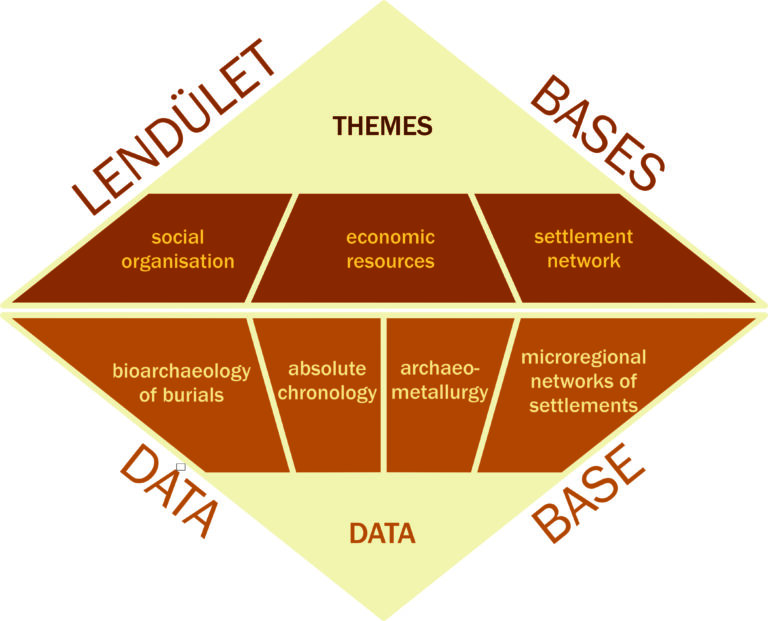
Thematic groups and databases of the MTA–ELTE HTK Lendület “Momentum” BASES Research Group (graphics: Nóra Szabó)