A Short Film on the Creation of the First Bronze Age Female Facial Reconstruction from Hungary
In 2022, the first Bronze Age female facial reconstruction from Hungary was created on the basis of a skull unearthed from one of the graves in the prehistoric cemetery at Balatonkeresztúr–Réti-dűlő. The crew of the Katt(anj) a tudományra (“Click into Science”) project is producing a short film about this work, presenting both the story of the community that lived four millennia ago and the detailed steps of the reconstruction process.
Excavation of the Grave
At the Balatonkeresztúr–Réti-dűlő site, excavations preceding the construction of the M7 motorway uncovered a cluster of burials containing the remains of 11 individuals. Radiocarbon analyses confirmed that the deceased—laid in a flexed, “sleeping” position—were interred during the Early Bronze Age. Most of the graves lacked any associated grave goods, with only two exceptions where items associated with clothing or personal adornment were recovered. In Grave 10, the only child in the grave group wore a bracelet made from a bent sheet of bronze on the wrist. In Grave 13, fragments of small copper or bronze beads were found beneath the head of an adult woman.
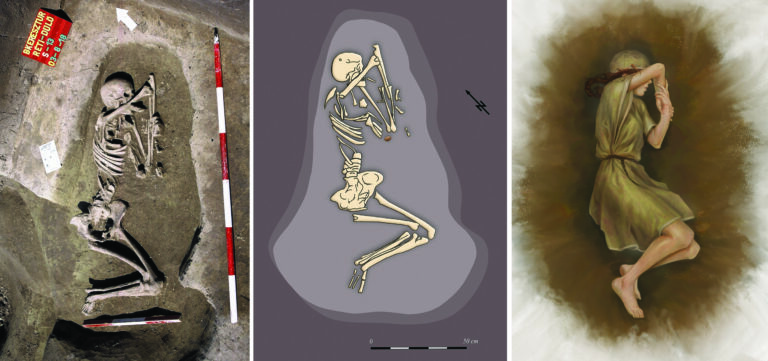
Burial of a middle-aged woman (35–45 years) and its potential reconstruction, Grave 13 from Balatonkeresztúr–Réti-dűlő (Kustár et al. 2022, Fig. 2)
Who Was Jelena?
The skull of the woman buried in Grave 13—who died at approximately 35–45 years of age—was preserved in exceptionally good condition. Thanks to the interdisciplinary collaboration within the MTA–BTK Lendület “Momentum” Mobility Research Group, it became possible to reconstruct the facial features of this woman, who lived between 2040 and 1890 BCE.
Because no written sources are known from the Bronze Age, the names of the individuals belonging to the community that once inhabited the settlement at Balatonkeresztúr remain unknown. On the day of the excavation, 18 August 2003, the calendar listed the name days Ilona, Elena, Jelena, and Lenke. Ultimately, inspired by the letter “J” identifying her mitochondrial haplogroup, we chose the name Jelena for this middle-aged woman—a designation that also evokes the memory of perhaps the most renowned Bronze Age woman recorded in later Homeric epics: Helen of Troy.
The Facial Reconstruction
The first female facial reconstruction based on Bronze Age remains from Hungary was carried out by anthropologist and facial reconstruction specialist Ágnes Kustár. The project involved close collaboration with the excavation director of the Early Bronze Age cemetery, archaeologist Szilvia Fábián; anthropologist Kitti Köhler, who conducted the osteological analyses; bioinformatician Dániel Gerber, who coordinated the DNA studies; and lead archaeologist Viktória Kiss of the research group. In this way, the reconstruction was truly the result of a multidisciplinary team effort.
Following the excavation of the grave and the anthropological analyses, a CT scan of the skull was produced with the assistance of Semmelweis University.
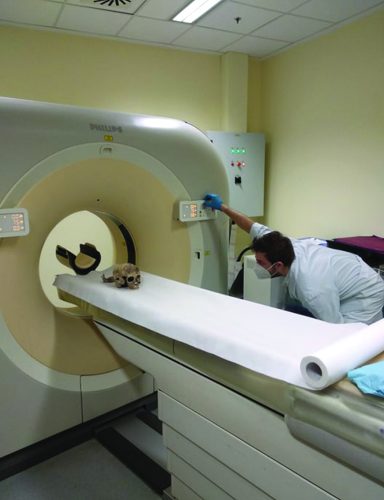
CT examination of the skull of the middle-aged woman (35–45 years) from Grave 13, Balatonkeresztúr–Réti-dűlő.
From these scans, a 3D-printed replica of the skull was created. Using this plastic copy, Ágnes Kustár sculpted the muscles and soft tissues in accordance with established anatomical and sculptural methods.
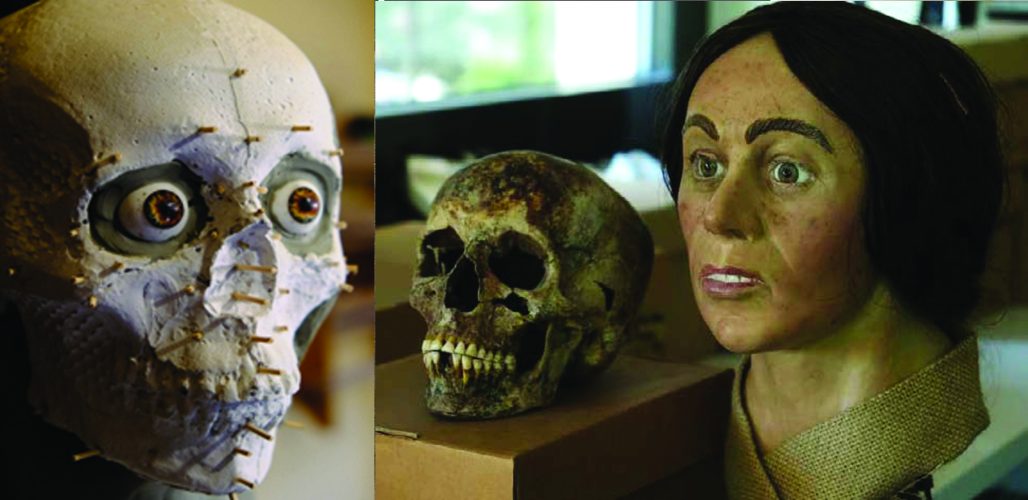
Sculptural facial reconstruction of the middle-aged woman’s skull with tissue-depth markers, alongside the original skull and the completed, coloured reconstruction, Grave 13, Balatonkeresztúr–Réti-dűlő (Kustár et al. 2022, Fig. 6; photo: Dániel Gerber).
What Did Jelena Look Like?
Archaeogenetic analyses indicate that, despite the steppe ancestry of the Balatonkeresztúr Bronze Age community, their skin was likely darker than the average modern European, resembling more closely that of previously known Neolithic populations. Accordingly, Jelena had medium-dark skin tone and darker blond-brown hair; her face, according to the DNA data, may have been freckled. Her eye colour was influenced by genetic variants associated with both blue and brown pigmentation. Based on this information, restorer Zsuzsa Herceg applied the colouring to the facial reconstruction—rendering the iris and skin tone—and designed a braided hairstyle using a wig.
The presence of a copper ornament suggests that this middle-aged woman held a higher social status within her community. She was likely dressed in garments made of linen or hemp when interred. Only a fragile copper bead survived from her attire, located on the left side of her skull; it may have been sewn onto a headpiece or cap, or used as a decorative element in her hair. Similar finds have been documented at the nearby Ordacsehi–Csereföld site, excavated by Krisztina Somogyi and Zsolt Gallina.
Short Film on the Research
Ágnes Kustár, who passed away in the summer of 2023, was unfortunately unable to participate in the filming of the documentary. Fortunately, the creation of the facial reconstruction had been recorded in several hours of video footage by Dániel Gerber.
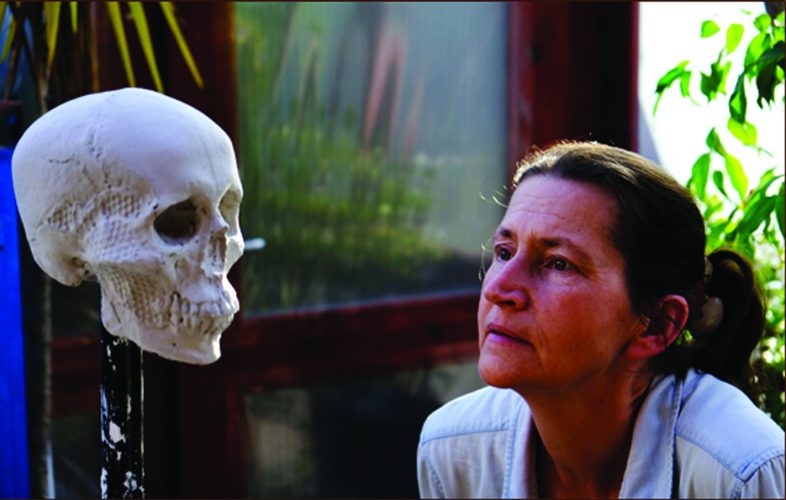
Ágnes Kustár with the plaster cast of Jelena’s skull (photo: Dániel Gerber).
The documentary produced by the Katt(anj) a tudományra team allows viewers to follow the process behind the creation of a lifelike facial reconstruction of a Bronze Age woman from Hungary. The short film also presents the Bronze Age settlement near Lake Balaton and the Nagyberek, where Jelena and her community may have lived. With the participation of Krisztina Somogyi, a member of the Rippl-Rónai Museum in Kaposvár—which curates the finds from the settlement and the graves—and by showcasing the archaeological site, the film summarizes the results of the excavation conducted more than two decades ago.
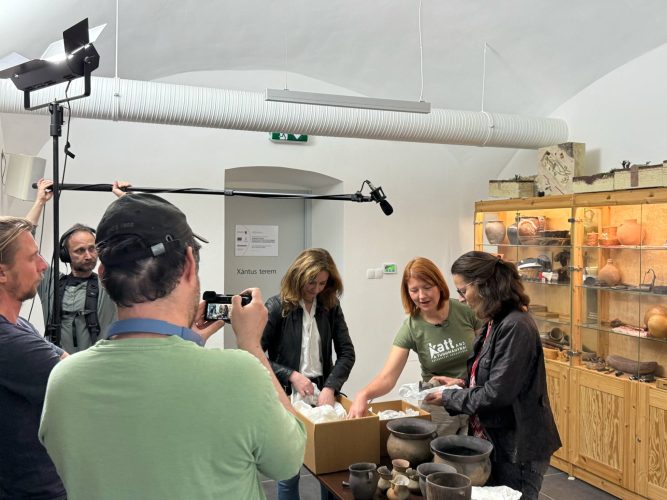
Filming of the Katt(anj) a tudományra short documentary at the Rippl-Rónai Museum (photo: Dániel Gerber).
Key publications on the research:
Fábián, Sz., Serlegi, G.: Settlement and environment in the Late Copper Age along the southern shore of Lake Balaton in Hungary. In: T. Thurston / R. B. Salisbury (eds.), Regional Analyses of Spatial and Social Dynamics. Cambridge 2009, 199–231.
Gerber, B. Szeifert, O. Székely, B. Egyed, B. Gyuris, J. I. Giblin, A. Horváth, K. Köhler, G. Kulcsár, Á. Kustár, I. Major, M. Molnár, L. Palcsu, V. Szeverényi, Sz. Fábián, B. G. Mende, M. Bondár, E. Ari, V. Kiss, A. Szécsényi-Nagy: Interdisciplinary Analyses of Bronze Age Communities from Western Hungary Reveal Complex Population Histories. Molecular Biology and Evolution 40, 2023.
Honti, Sz., Belényesy, K., Fábián, Sz., Gallina, Zs., Hajdu, Á.D., Hansel, B., Horváth, T., Kiss, V., Koós, I., Marton, T., Németh, P. G., Oross, K., Osztás, A., Polgár, P., Pásztókai-Szeőke, J., Serlegi, G., Siklósi, Zs., Sófalvi, A. and Virágos, G.: A tervezett M7-esautópálya Somogy megyei szakaszának megelőző régészeti feltárása (2002–2003) Előzetes jelentés III. / Preliminary Report III. The preceding archaeological excavations (2002–2003) of the M7 highway in Somogy county. Somogyi Múzeumok Közleményei 16 (2004) 3–70.
Honti, Sz., Fábián, Sz., Gallina, Zs., Hajdu, Á. D., Hornok, P., Koós, I., Mersdorf, Zs., Molnár, I., Németh, P. G., Polgár, P., Pásztókai-Szeőke, J., Serlegi, G., Siklósi, Zs., Sipos, C. and Somogyi, K.: Régészeti kutatások az M7-es autópálya Somogy megyei szakaszán és a 67-es úton (2004-2005). Előzetes jelentés IV. / Archaeological research on the Somogy county section of the M7 highway and on the Route No. 67. Preliminary report IV. Somogyi Múzeumok Közleményei 17(A) (2007) 26–29.
Kiss, V., Gerber, D., Fábián, Sz., Szeifert, B., Giblin, J. I., Á. Kustár, V. Szeverényi, B. Gyuris, A. Horváth, L. Palcsu, K. Köhler, G. Kulcsár, B. G. Mende, E. Ari, A. Szécsényi-Nagy: Lifeway Narratives of a Bronze Age Community from Balatonkeresztúr (Western Hungary) Based on Bioarchaeological Analyses. In: H. Meller, J. Krause, W. Haak, R. Risch (eds.) Kinship, Sex, and Biological Relatedness: the Contribution of Archaeogenetics to the Understanding of Social and Biological Relations. 15. Mitteldeutscher Archäologentag vom 6. bis 8. Oktober 2022 in Halle (Saale). Halle (Saale): Landesamt für Denkmalpflege und Archäologie Sachsen-Anhalt. Landesmuseum für Vorgeschichte 2023, 233–248.
Kustár, Á., Gerber, D., Fábián, Sz., Köhler, K., Mende, B. G., Szécsényi-Nagy, Á., Kiss, V.: Facial Reconstruction of an Early Bronze Age Woman from Balatonkeresztúr (W-Hungary). Antaeus 38 (2022) 11–30.
Kustár Á., Gerber D., Fábián Sz., Köhler K., Mende B. G., Szécsényi-Nagy A., Kiss V.: Bronzkori nő szobrászi arcrekonstrukciója Balatonkeresztúr-Réti-dűlő lelőhelyről. Antropológiai Közlemények 63 (2022) 13–16.
Somogyi K.: Fejdíszes női sír a kora bronzkorból. In: Belényesy K., Honti Sz., Kiss V. (szerk.): Gördülő idő. Régészeti feltárások az M7-es autópálya Somogy megyei szakaszán Zamárdi és Ordacsehi között / Excavations on the M7 Motorway in County Somogy between Zamárdi and Ordacsehi. Kaposvár–Budapest 2007, 207–208.