Beyond Borders: Czech Guest Researchers in Hungary – Part 4
In 2023, the Institute of Archaeology ELTE Research Centre for the Humanities and the Institute of Archaeology of the Czech Academy of Sciences in Prague were awarded bilateral international research mobility funding. The scheme supports investigations into the connections between Western Hungary and Central Bohemia during the period between 2200 and 1500 BC. Within the framework of this two-year project, led by Viktória Kiss and Daniel Hlásek and introduced in our earlier post, two early-career colleagues from the Czech Academy of Sciences’ Institute of Archaeology undertook a week-long research visit to Hungary in the autumn of 2025.
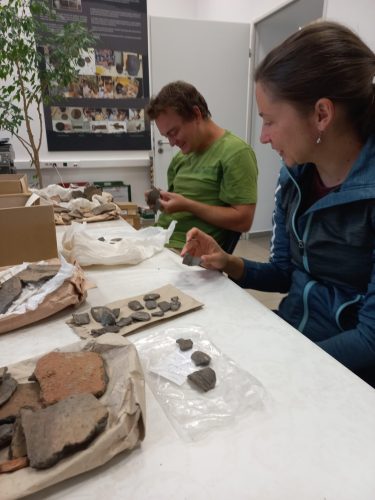
Michaela Kosová and Daniel Hlásek in the storeroom of the Rómer Flóris Museum of Art and History, Győr
Michaela Kosová and Daniel Hlásek arrived in Győr on 5 October 2025, where they were able to examine assemblages from Middle Bronze Age settlements and cemeteries in the storerooms of the Rómer Flóris Museum of Art and History. We extend our thanks to Krisztina Pesti and Bálint Savanyú for their assistance in preparing the material. The following day, we visited the modern exhibitions of the Sopron Museum Quarter, where Attila Mrenka guided us through the Sopron Eternal! permanent archaeological display.
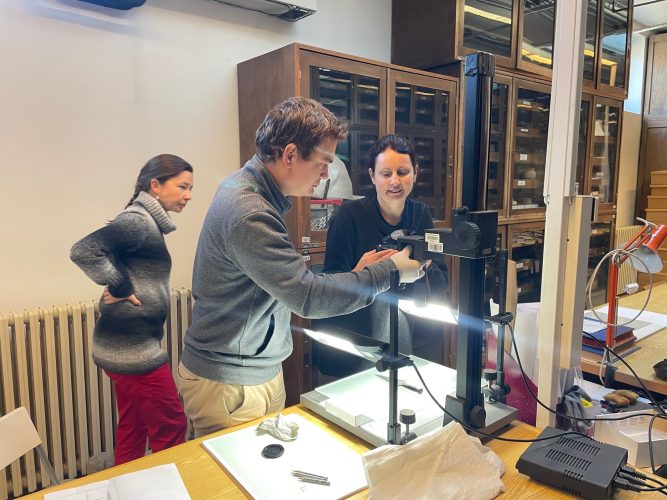
Photographing in the Prehistoric Collection of the Hungarian National Museum (Photo: Nóra Szabó)
The second half of the visit took place in Budapest, where the researchers first explored the permanent archaeological exhibition of the Hungarian National Museum. A further focus of our project concerns solid-hilted daggers, which appear in Bohemia and sporadically in Hungary during this period. In this context, and thanks to János Gábor Tarbay, we had the opportunity to document the Szentgál dagger belonging to this type in the Prehistoric Collection of the Hungarian National Museum’s Archaeological Department. Alongside a brief tour of the city, we also devoted time to preparing for the conference presentation scheduled for the following week, as well as to adding entries to the database of related artefacts from the two regions, which will form the foundation of our forthcoming publication. We shall report shortly on our participation in the conference in Slovakia in a subsequent post.