Bronze Age Life Stories from Hungary — Volume 5 of the Hereditas Archaeologica Hungariae Series Published
In a newly published volume entitled Bronze Age Life Stories from Hungary (3rd–2nd millennia BC), Viktória Kiss presents the results of nearly a decade of research in a readable yet academically rigorous manner. One of the aims of the Lendület research programme, which she has led since 2015, was to uncover the stories of individuals within Bronze Age societies some 4,000 years ago, using interdisciplinary methods that bridge several fields of study. The volume, now available in both Hungarian and English, will be formally launched in October 2025 within the framework of the MTA 200 programme.
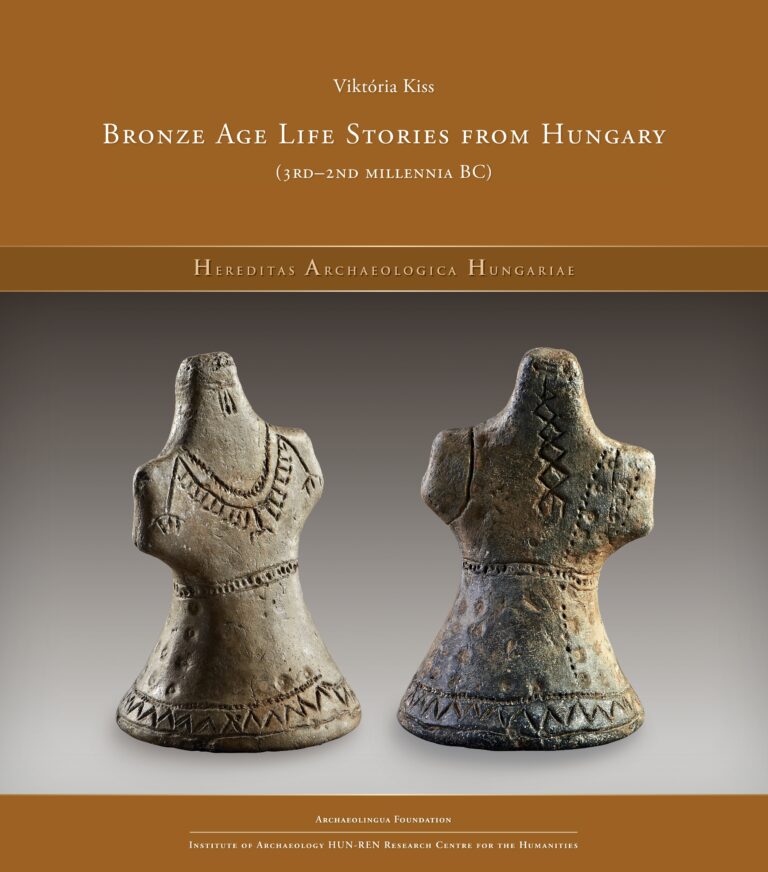
In this richly illustrated book, Kiss — the head of our research group — moves away from the usual “bird’s-eye view” and instead places history under a kind of microscope, bringing closer to today’s reader the period of the first half of the Bronze Age, which lasted for nearly two millennia in the Carpathian Basin. The author introduces the communities who settled in what is now Hungary prior to the age of the Trojan War and explores who they were and the conditions under which they lived. These communities were contemporaries of the pharaohs who built the great pyramids and the rulers who inhabited the palaces of Minoan Crete.
Since no written sources survive concerning the lives of people in prehistory, it is a remarkable opportunity that modern archaeology — through the 21st-century methods of numerous branches of the natural sciences — can expand our understanding of past events and individuals. The close cooperation of different disciplines has given rise to a new scientific field, bioarchaeology, which in many respects resembles the work of forensic investigators and likewise relies primarily on human remains. When complemented by behavioural, environmental and social perspectives, such research enables biosocial archaeological analysis. As a result, it is not the skeleton but the former person who becomes the primary subject of investigation.
The volume presents a selection of the case studies published to date by the MTA–BTK Lendület Mobility Research Group (2015–2022) and the MTA–BTK Lendület Bases Research Group (2023–2028), providing insights into the lives of Bronze Age elites, warriors, craftspeople and families — women, men and children — who settled in Hungary between 2500 and 1500 BC.
Volume 5 of the Hereditas Archaeologica Hungariae book series has been published jointly by the Institute of Archaeology and Archaeolingua Press, with the support of the Hungarian Academy of Sciences’ Book and Journal Publication Grant.