Interview and Book Review on Műemlékem.hu – Presentation of Viktória Kiss’s New Volume Bronze Age Life Stories from Hungary (3rd–2nd millennia BC)
In the Közkincs-kereső podcast series of Műemlékem.hu, editor Olivér Kovács spoke with Viktória Kiss about her new volume, published in both Hungarian and English as the fifth book in the Hereditas Archaeologica Hungariae series. The interview touched upon the most recent twenty-first-century methods in archaeological research, which have enabled scholars to illuminate details of the lives of individuals associated with both elite and less prominent social groups of Bronze Age society. The discussion also addressed the first facial reconstruction of a woman who lived in Bronze Age Hungary, whose facial features, as well as the colour of her eyes, skin and hair, could be determined through archaeogenetic analysis.
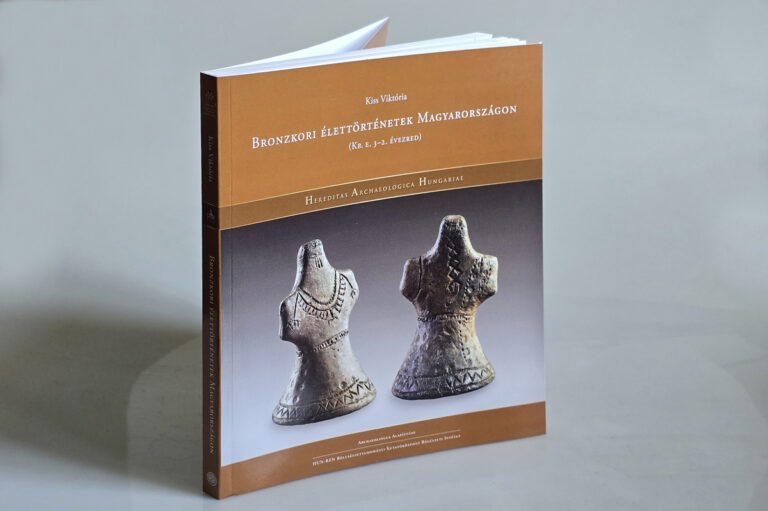
Quoting from the book review published on Műemlékem.hu:
“Bronze Age Life Stories from Hungary is a truly indispensable volume. The term ‘indispensable’ often appears as a cliché in book reviews, yet in this case it is entirely justified: to such an extent, indeed, that until now anyone interested in the period of the 3rd–2nd millennia BC (more precisely 2500–1500 BC) and wishing to read popular scholarship rather than specialist articles had only Tibor Kovács’s The Bronze Age in Hungary to turn to, a book published in 1977. Although not a particularly substantial volume, it was at least a well-crafted synthesis at the scholarly level of its time – but it now fully betrays the nearly half-century that has passed since its appearance.
It is therefore refreshing to open the more substantial, richly illustrated volume by archaeologist Viktória Kiss, Senior Research Fellow at the Institute of Archaeology, HUN-REN Research Centre for the Humanities and head of the MTA–BTK Lendület Bases Research Group. The author explicitly highlights the quantitative and qualitative expansion of available information made possible by advances in research methods, signalled already by the fact that she begins the book with an in-depth presentation of these methods. Thus, at first, we are offered not ‘life histories’ but methodology and auxiliary disciplines – yet this, too, is well worth reading carefully, as it clarifies why we now know so much more about finds and assemblages than we did decades ago. The ‘life histories’ always unfold from specific excavation results; in other words, the author does not attempt to craft a kind of ‘Bronze Age history book’, which, given the nature of the period and the lack of written sources, would be highly uncertain in any case. Instead, we become acquainted with personal stories – that is, elements of life histories – that rest on firm, scientifically verifiable foundations.”