Building on our previous multidisciplinary work, the project creates a 21st-century digital storage system for this extensive dataset and publish it on multiple levels in three thematic groups, which continue the approved track record of the Momentum Mobility Research Group:
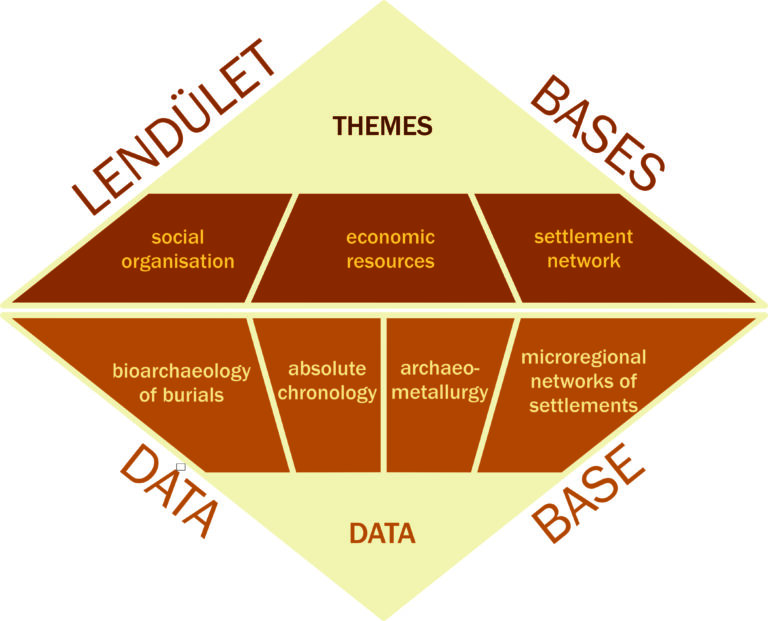
(1) Social Organization Thematic Group
(2) Economic Resources, Metalworking Thematic Group
(3) Settlement Network Thematic Group
The thematic groups partially overlap in terms of research questions and participants.
The structure of the research groups and databases (graphics: Nóra Szabó)
Database development
As part of a new initiative by the ELTE RCH Institute of Archaeology, entitled the Digital Archaeological Atlas of Hungary, we plan to develop cloud-based thematic, multi-level databases with complete access for professionals and researchers, but restricted for the general public. To this end, we will construct comprehensive thematic databases drawing on data from the micro-regions studied, relative and absolute chronological data on human remains from settlements and graves, the results of object biographies and material analyses of ceramic and metal finds. Within this Bronze Age (2500–1500 BC), we will develop four thematic databases: (1) the complex bioarchaeological data of burials, (2) archaeometallurgical data on metal objects, (3) absolute chronological data, and (4) microregional settlement networks.
Models derived from these databases will support the assessment of changes in the Carpathian Basin in a broader Eurasian context, and are also closely linked to the development of new research directions, archaeological heritage protection, museology, and education. The databases can also serve as a starting point for a diachronic summary of the economic resources of the Carpathian Basin, bringing us closer to answering the most important questions that have been asked repeatedly over the past century of Bronze Age research: how the advent of bronze reshaped social stratification and how settlement, interaction, and route networks—still forming the basis of our region’s economic and social structure—emerged?
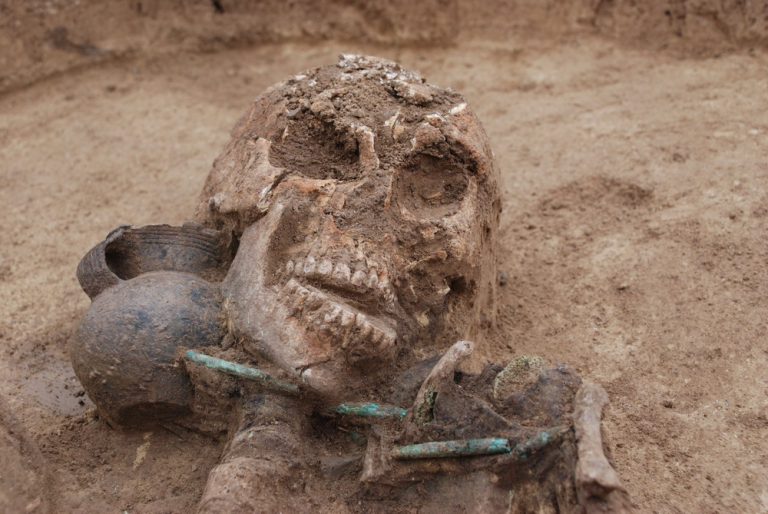
Skeletal burial with pottery and metal grave goods from Bonyhád-Biogas factory site (Szabó 2010)
Traditional typological archaeological examination of the finds will be complemented by new statistical methods (e.g., seriation, correspondence analysis) and scientific examinations (petrography, X-ray fluorescence, neutron activation analysis, laser ablation). The manufacturing technique and quality, raw materials, and formal and decorative characteristics of the pottery sets placed in the graves may shed light on a long-standing question in Bronze Age archaeology: to what extent burial rites mirrored everyday life?
Relative and absolute chronology
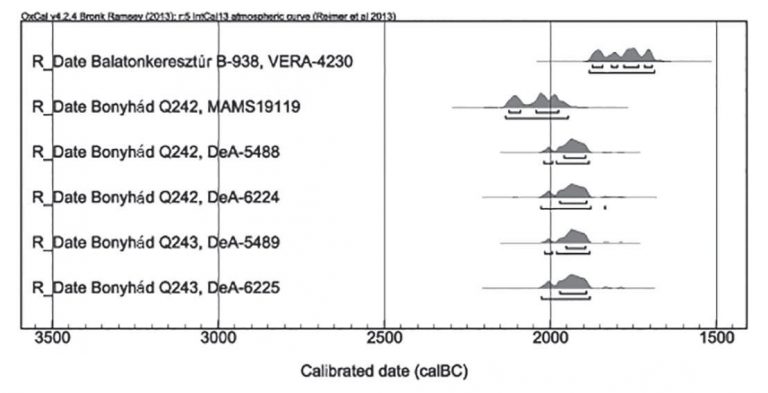
We consider it important to refine the radiocarbon data collection that began two decades ago. We plan to supplement the AMS measurements carried out within the framework of the Momentum Mobility Research Group with 100 new data points and publish them in peer-reviewed journals. We will refine the absolute chronology of the Hungarian Bronze Age by dating the inorganic bioapatite component of cremated bones (instead of collagen), thereby supplementing the fragmentary series resulting from the increasing prevalence of cremation in the period. In addition to burials, the absolute dating of sites researched by the settlement theme group also plays an important role.
Absolute data for skeletal burials from the Kisapostag culture and the Transdanubian Encrusted Pottery culture (Kiss et al. 2015a)