Our Research Group Featured in the June Issue of National Geographic
In recent years, readers of the National Geographic Hungary online portal have been able to follow the work of the MTA–BTK Lendület ‘Momentum’ Mobility Research Group, established in 2015 with the support of the Lendület programme (see here, here, and here). More recently, the June issue of the magazine’s print edition reported on the aims of the MTA–BTK Lendület ‘Momentum’ Bases Research Group, founded within the programme’s “Advanced” category (for details, see the interview published in the Lendületesek series on the MTA website). The printed article was illustrated with our reconstruction of the chief buried between 1950 and 1900 BC in the area of present-day Balatonakali. The reconstruction was made possible by our analyses of the grave goods and human remains, as well as by data collected on the characteristic dress of the period.
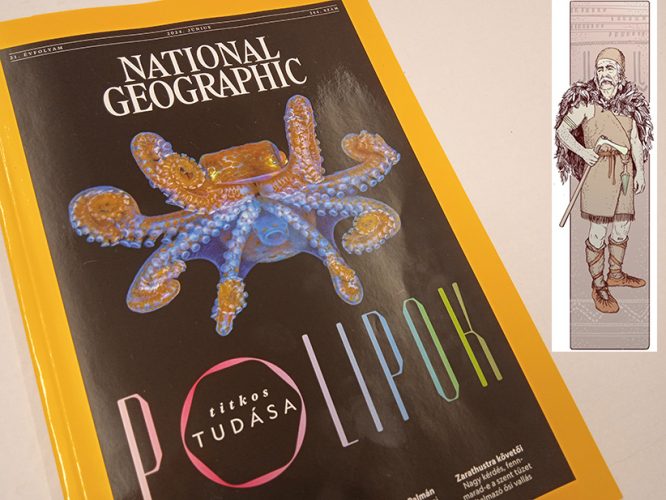
Cover of the June 2024 issue of National Geographic and a reconstruction of the Balatonakali chief’s attire (illustration: Dávid Ringeisen)
It is a curious coincidence that only a few pages after the report on our research group, the magazine includes a short article discussing a Babylonian cuneiform text written almost contemporaneously with the Balatonakali chief—dating to the 1700s BC. This inscription, recognised by the Guinness Book of Records as the world’s first recorded complaint letter, was produced in the ancient city of Ur. The clay tablet, now housed in the British Museum, preserves the grievances of a dissatisfied customer who claimed that a Babylonian merchant named Ea-nāṣir had sold him copper of poor quality.
Our research findings suggest that the Balatonakali chief, by virtue of his power and status, acquired nearly one kilogram of copper for his weapons and jewellery from one of the best ore sources in contemporary Europe—most likely the present-day Spiš–Gemer (Slovak Ore Mountains) region. He therefore could hardly have fallen victim to a merchant intent on deception. His elevated social standing is further reflected in the fact that the axe, dagger, chisel, adze, and spiral arm-ring buried with him contain, according to metallurgical analyses, 5–10% tin in addition to copper. These artefacts thus rank among the earliest tin-bronze objects in the Carpathian Basin (Pare 2000; Kiss 2020).
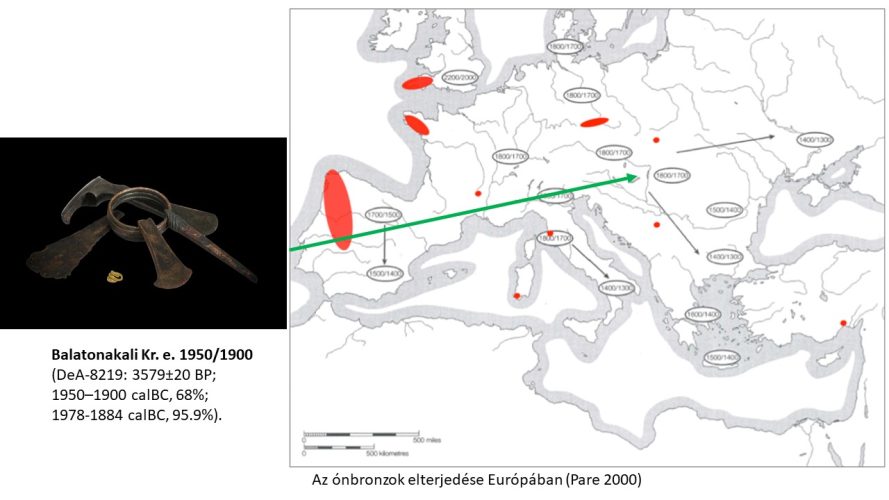
Bronze artefacts from the Balatonakali grave and the distribution of tin bronzes in Europe (Photo: Péter Hámori; Map: Pare 2000)
References
Kiss, V.: The Bronze Age burial from Balatonakali revisited. In: Maran, J., Sorin-Christian, A., Bajenaru, R., Hansen, S. (eds.): Objects, Ideas and Travelers. Contacts between the Balkans, the Aegean and Western Anatolia during the Bronze Age and Early Iron Age. Conference to the Memory of Alexandru Vulpe. 10th-13th November 2017, Tulcea, Romania. Tulcea 2020, 553–568.
Pare, C.: Bronze and the Bronze Age. In C. Pare (ed.) Metals Make the World Go Round. The Supply and Circulation of Metals in Bronze Age Europe. Proceedings of a conference held at the University of Birmingham in June 1997. Oxford 2000, 1–38.
Viktória Kiss