Recent Publications on Bronze Age Metallurgy and Society
During the summer, Gondolat Publishing House released the edited volume Migration of Material and Cultural Goods in the Carpathian Basin (Anyagi és szellemi javak migrációja a Kárpát-medencében), prepared under the editorship of Katalin Mária Kincses. The book contains the papers in Hungarian presented at the 11th Symposium of the Handicraft History Working Committee of the Veszprém Regional Committee of the Hungarian Academy of Sciences (VEAB), held on 10–11 November 2022. Connecting theoretical and practical approaches to migration, the volume presents the latest results of research into the history of craftsmanship in Hungary. It can now be said that traditional approaches—typically focusing on particular objects, object groups, or artisanal techniques—have largely been replaced by a highly multifaceted research framework. This new approach integrates the various branches of historical studies (including economic, social, legal, administrative, urban, industrial, and technological history) together with related disciplines, most notably ethnography and archaeology, applying them not separately but in combination. As a result, the horizons of research have significantly expanded both spatially and temporally. In their contribution to the volume, Viktória Kiss and Beatrix F. Romhányi summarise archaeological and historical evidence for the trade of copper raw materials and finished products in the Carpathian Basin, drawing on diachronic analyses spanning multiple historical periods.

The cover of the volume (Gondolat Publishing House)
The volume contains the following studies (in Hungarian):
- Katalin Mária Kincses: The Migration of Material and Cultural Goods (Preface)
- Mária Fekete: Highly Skilled Antler Carvers Arrived in Transdanubia
- Viktória Kiss – Beatrix F. Romhányi : Raw Material Trade and/or Travelling Craftspeople? Data for a Diachronic Examination of Copper Raw Materials and Finished Products in the Carpathian Basin
- Szabolcs László Kozák-Kígyóssy : In the Shadow of Trade: Western Imports and Their Relationship to the Craft of Knife-Making in Late Medieval Hungary
- Katalin Mária Kincses: Lessons from Comparing Journeyman Mobility and University Peregrination in the Context of Early Modern Labour Migration within the Carpathian Basin
- Csilla Tuza: The Migration and Local Adaptation of German Imperial Guild Regulations and Measures
- Claudia Wunderlich: Card Manufacturing and Networks of Connection in Nineteenth-Century Hungary: The Case of the Unger Family of Győr
- Zsuzsánna Paál: Artisanal Ceramic Stoves in the Austro–Hungarian Monarchy: On the Presence of the Brüder Sattler Factory in Hungary
- Zoltán Nagy: The Beginnings of Folk Applied Arts in Magyarszombatfa: The Origins and Diffusion of ‘Írókás’ Slipware Decorative Motifs—Side-View Tulip, ‘Hen’s Foot’ Pattern, and Four-Petalled Rose—Introduced in Pottery Courses of the 1930s
- Fruzsina Cseh: Centralised Management of the Folk Art Trade in Hungary up to the Second World War
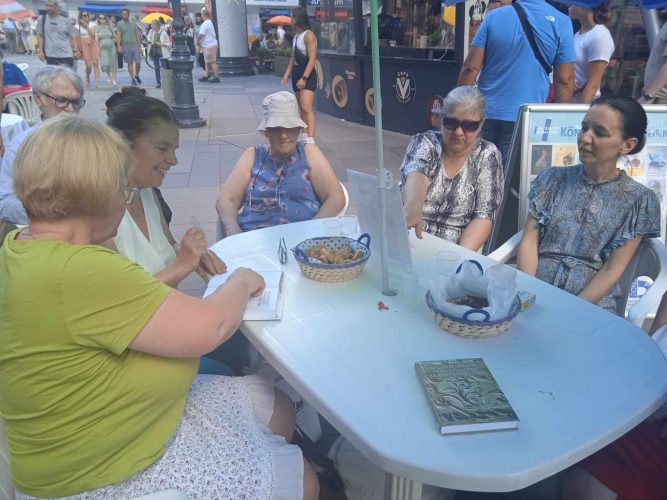
Book signing with the authors at the Book Festival (Photo: Viktória Kiss)
A short article by Viktória Kiss, titled New Methods in the Study of Bronze Age Society: Biosocial Archaeological Analyses (Új módszerek a bronzkori társadalom kutatásában. Bioszociális régészeti elemzések) has been published in issue 37 of Élet és Tudomány in Hungarian. The piece offers an overview of new bioarchaeological and biosocial research methods that complement traditional approaches in social archaeology. Until recently, the kinship ties that held together Bronze Age communities living between 2500 and 800 BC could only be hypothesised—for example, on the basis of grave clusters containing a few adults alongside numerous children.
In many respects, bioarchaeology resembles forensic investigation, as its primary source of evidence likewise consists of human remains. When combined with behavioural, environmental, and social perspectives, these studies make possible a form of biosocial archaeological analysis. As a result, the focus of research can shift from the skeleton itself to the individual once embodied by it.
The MTA–BTK Lendület Mobility and Lendület BASES Research Group has produced a series of isotopic, geochemical, and archaeogenetic case studies that provide exceptionally valuable insights into the bioarchaeology and biosocial history of Bronze Age families in what is now Hungary. These studies have illuminated the genetic heritage, diseases, physical appearance, biological kinship networks, and marriage practices of past communities. The article highlights several of the most important results published in recent years.
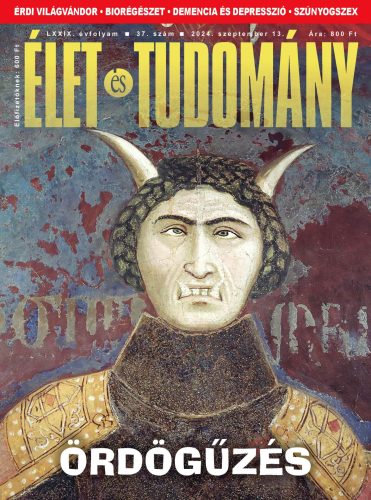
The cover of Élet és Tudomány, issue 79/37
Viktória Kiss