Recreating Bronze Age Fermenting Vessels: An Experimental Archaeological Firing at Kisasszony Lake
Members of our research team recently participated in an experimental archaeology project at Kisasszony Lake near Simontornya, where reconstructed Bronze Age ceramic vessels were fired. In the weeks leading up to the event, our colleague László Gucsi oversaw the construction of an experimental grate kiln. As a result, the firing was significant not only for the successful production of the vessels but also as an opportunity to test the performance and functionality of the kiln itself.
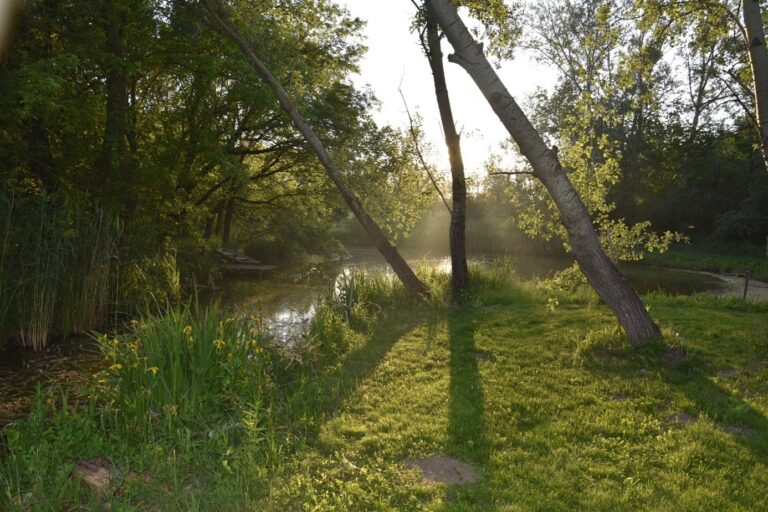
Kisasszony Lake at sunset in May.
The firing was carried out as part of the BEER project, a collaborative initiative involving several institutions. The project’s primary aim is to investigate the function of the so-called fermenting vessels that were widespread during the Early and Middle Bronze Age through the application of experimental archaeological methods. These vessels have long attracted scholarly attention because of their distinctive morphological and technological features, including interior knobs, roughened inner surfaces, perforations below the rim, ribbed decoration, and rounded bases. Numerous hypotheses have been proposed regarding their function. Previous research has associated these vessels with meat preservation, fermentation, the processing of dairy products, bread making, as well as the production of alcoholic beverages.
The project carried out as a multidisciplinary research programme led by Szabó Nóra. As part of the investigation, organic residue analyses have already been conducted on several fermenting vessels; however, further studies are required to obtain more conclusive results. The experimental archaeology component of the project is coordinated by Szabó Nóra and László Gucsi. During the first phase of the programme, several artefacts associated with the Middle Bronze Age Vatya culture were reconstructed, accompanied by detailed documentation of the manufacturing process. Among these were three reconstructions of fermenting vessels.
The second phase of the experiment involved the construction of the kiln and the firing of the vessels. Thanks to the generous support of Kornél Bencze, the kiln could be built beside the Kisasszony Lake. The kiln featured an internal partition and a grate structure, with its stability ensured by brick walls coated with clay plaster on both the interior and exterior surfaces. The firing chamber above the grate measured 65 × 78 cm, making it uncertain before the firing whether all the vessels could be accommodated at once. In addition to vessel types associated with the Vatya culture and the hypothesised Bronze Age brewing process, László Gucsi also produced a range of artefacts representing different periods of the Bronze Age. In total, 27 ceramic vessels were fired, including small cups, jugs, bowls, cooking pots, storage vessels, and fermenting vessels. Ultimately, the assemblage could only be accommodated through two separate firing events.
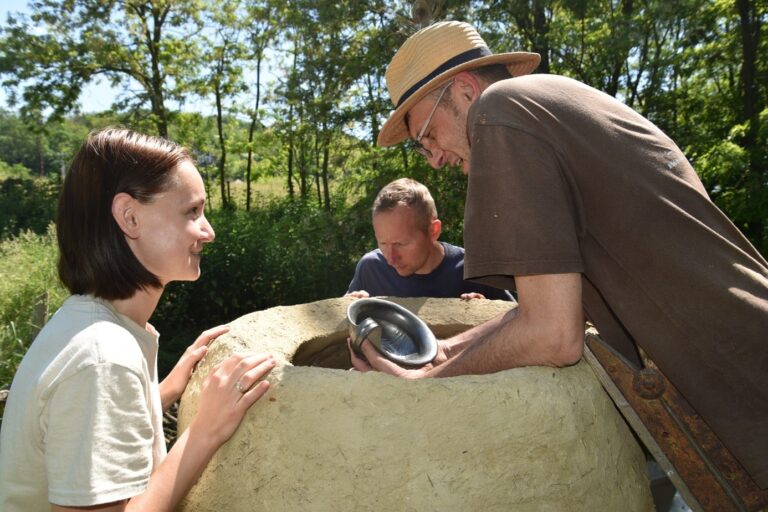
Admiring a replica of a Late Bronze Age vessel before placing it in the kiln.
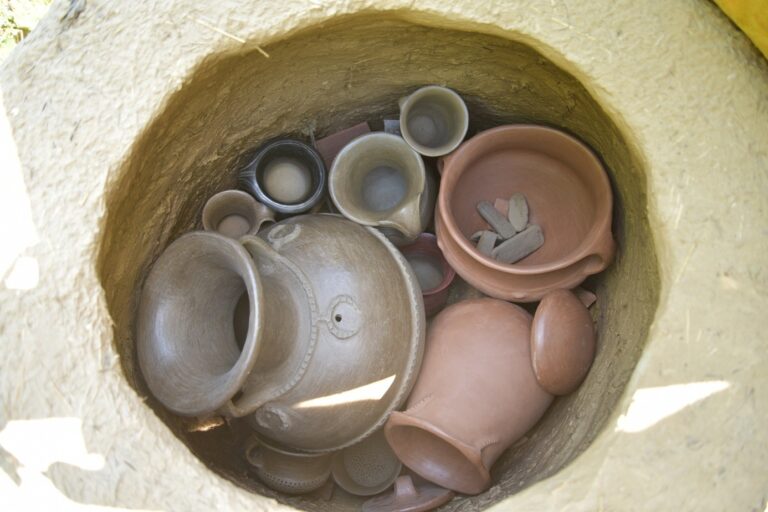
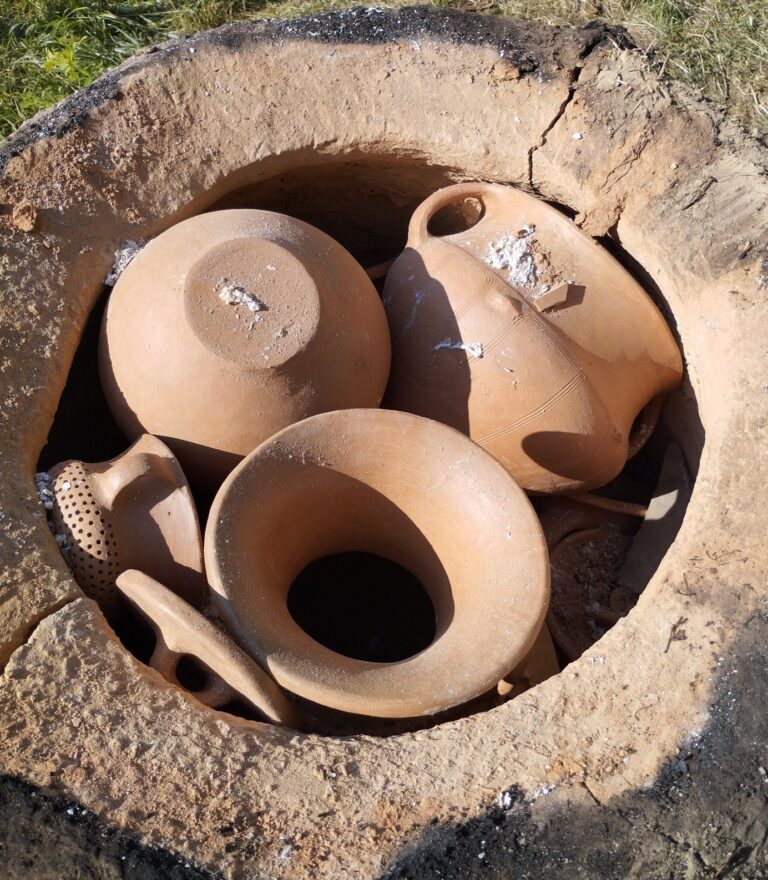
Preparing for the first firing: a fermenting vessel takes centre stage.
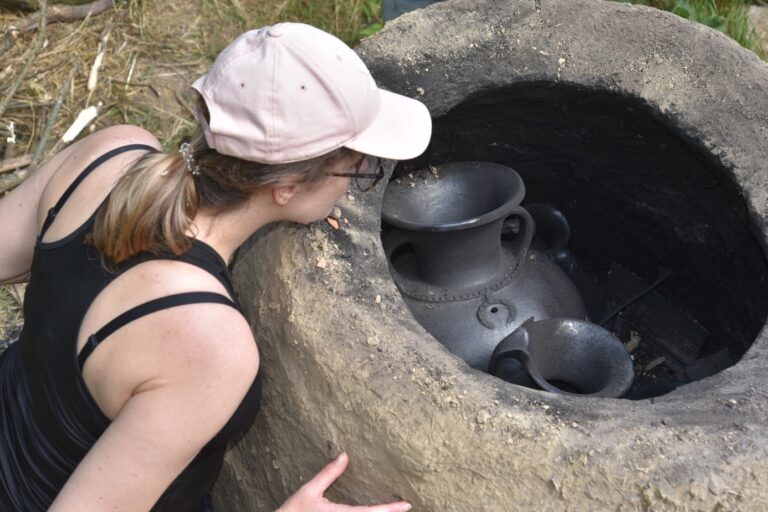
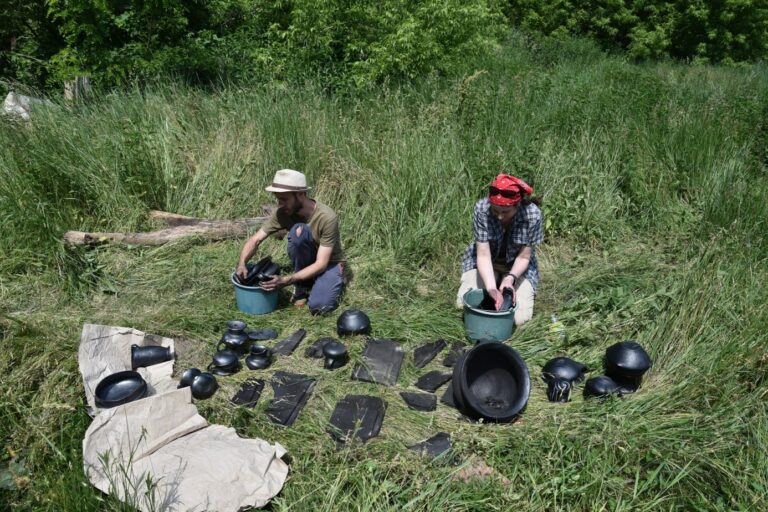
Two different firing techniques were employed during the experiment. In the first case, our aim was to achieve a dark, black surface colour. After reaching the approximately 700°C temperature required for successful firing, the kiln was sealed and the vessels were left to cool overnight in a reducing atmosphere. The second firing was carried out in an oxidising environment, with the goal of producing reddish surfaces with occasional mottling. During this process, the kiln temperature exceeded 800°C. The three-day firing programme was completed successfully. The kiln performed as intended, all vessels survived the process intact, and the desired surface colours were successfully achieved.
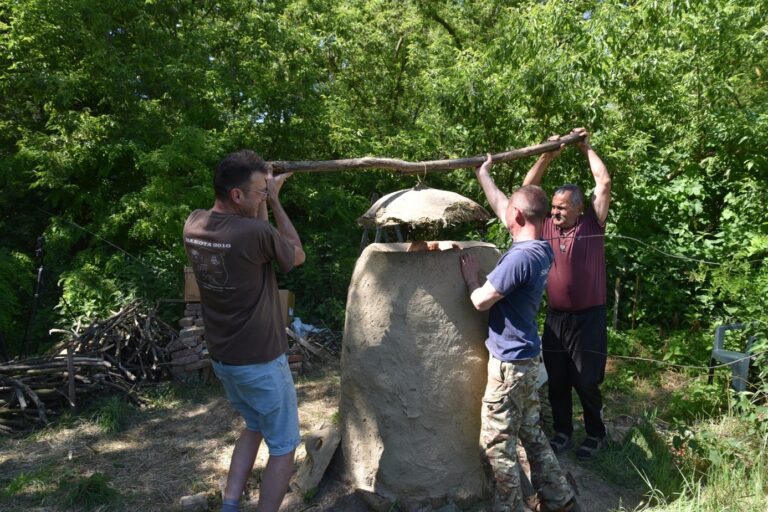
Our hosts also played an important role in sealing the kiln.
A glimpse of the results of the first firing.
Cleaning vessels fired in a reducing atmosphere.
Most importantly, the vessels essential to the project were successfully fired during the second firing and emerged in excellent condition.
The next stage of the project will concentrate on the experimental investigation of vessel use, with the objective of testing the validity of previously proposed hypotheses. As part of this programme, we intend to undertake an experimental brewing project using exclusively ingredients that would have been available in the Bronze Age.
The firing was a genuine collaborative effort involving researchers from several institutions as well as local supporters. During the construction of the kiln, László Gucsi was assisted by Máté Piros-Pozdora (National Institute of Archaeology, MNM). The firing itself was carried out by members of our research team, including László Gucsi, Nóra Szabó, Eszter Melis, and Kristóf Fülöp (Institute of Archaeology, ELTE RCH), with additional assistance from Polett Kósa (Hungarian National Museum). We would also like to express our special thanks to our hosts, Kornél Bencze and Imre Miklós, whose generosity extended far beyond providing the venue. Their continuous support, assistance, and hospitality were invaluable throughout the entire project.