Viktória Kiss successfully defended her dissertation awarding the title of Doctor of the Academy
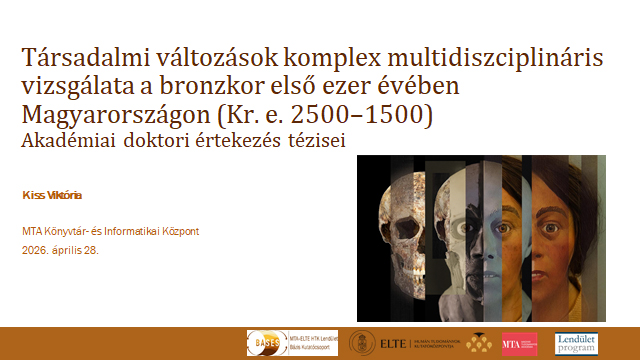
The PI of the Momentum “Lendület” Bases Research Group, Viktória Kiss successfully defended her DSc dissertation entitled A Complex Multidisciplinary Study of Social Changes in Hungary During the First Millennium of the Bronze Age (2500–1500 BCE) on April 28. The dissertation’s reviewers were Mária Bondár archaeologist, Doctor of the Academy, Gábor Újváry geochemist, Doctor of the Academy, and Gábor Szabó archaeologist, PhD.
The dissertation examines the processes that took place during the first thousand years of the nearly two-thousand-year-long Bronze Age in the Carpathian Basin, a period that coincided with the emergence of the ancient Eastern empires, the Egyptian pyramids, and the city-states of the Sumerian and Akkadian civilizations in Mesopotamia; at the end of this period, the palaces of the Minoan and Mycenaean cultures were built, and based on Linear A and B inscriptions, the formation of Europe’s first states may have begun at this time in present-day Crete and Greece (Driessen 2008; Parkinson–Gataly 2009). Some researchers reconstruct the processes leading to the formation of the state also in the western Mediterranean region between 2250–1550 BC, following the excavation of the highland settlements of the El Argar culture in southern Spain (Lull et al. 2014).
The Bronze Age is generally identified with the emergence of chiedfdoms in Central and Northern Europe, the Bronze Age, which, with the institutionalization of social inequalities, marking a new stage between the emergence of competing, periodically prominent leaders and the formation of the earliest states (Earle 1991, 1997; Meller 2019a, 2019b). The region examined in this dissertation—the Carpathian Basin, and within it, present-day Hungary—played a significant role in the connections between ancient Eastern civilizations and European communities, and the spread of numerous innovations, realized between 3500 and 1500 BCE (Hansen 2014), including bronze craftsmanship, the first horse harnesses, the standardization of the weight system, and millet consumption across the entire continent. The network of relationships that emerged as a result of the procurement of bronze, a raw material made from an alloy of copper and tin, changed the course of human history. This is reflected in the concept of “bronzization,” derived from the combination of the words “globalization” and “bronze,” which focuses on the analysis of global and local phenomena rather than the so-called World System Theory (Vandkilde 2016). The dissertation examined the changes that occurred during the thousand-year period spanning the Early and Middle Bronze Ages in the Carpathian Basin and the broader region of Central Europe.
The findings regarding a society characterized by patrilocal ties and exogamous marriage customs, as revealed by bioarchaeological and archaeometric analyses, can be compared with previous examples of social reconstruction from this period. An examination of artefacts indicating social inequality and stratification shows that copper and bronze jewellery and weapons are found in 10–20% of graves. Amber ornaments were placed in 8–10% of graves in skeletal-ritual cemeteries, while gold hair rings and dress ornaments were found in only 2% of graves. Those who wore the small gold jewellery, the contemporary elite, may have been outranked by the owners of 300-gram gold bracelets. The latter, symbols of princely power, are not yet known from burials, but only from hoards buried in isolated locations or from scattered finds that ended up in museums under unknown circumstances. Their discovery, however, is not random; they likely indicate the seats of a few individuals at the top of contemporary society who controlled important transportation hubs, whose power extended not merely over a small river valley but over a larger region (Category 1a). The next group, Category 2, likely included those who possessed smaller copper and bronze artifacts. Category 3 comprises those buried with pottery and other objects, while the final Category 4 consists of those sent on their final journey without any grave goods. In addition to elite burials, the multi-tiered settlement system that emerged in the Carpathian Basin during the Early Bronze Age also points to growing social inequalities and the concentration of power. At the beginning of the Middle Bronze Age, the first tin-bronze objects—such as the weapons and tools from the chiefly grave at Balatonakali—indicate an interaction zone spanning 1,000–1,500 km between Melz in northern Germany and Slatina in Oltenia, within which long-distance trade had increased. Based on trade of gold and amber objects, imported jewelry, and weapons, contacts became more intense during the Middle Bronze Age, driven undoubtedly by the demand for copper raw material originating from the Gömör-Szepes Ore Mountains and, in the second half of the Middle Bronze Age, by the growing need for copper from the Eastern Alps.
The regional and interregional connections described in the dissertation became even more intense during the period following 1500/1450 BC. By this time, the vast quantities of bronze objects acquired through exchange networks had replaced tools previously made from other materials in every aspect of daily life. The expansion of raw material trade contributed to the emergence of a unified Eurasian weight system, marking the spread of globalization in the “expanded world” of the Late Bronze Age, stretching from the British Isles to India.
References
Driessen, J.: Chronology of Linear B texts. In: Y. Duhoux, A. M. Davies (eds.) A Companion to Linear B: Mycenaean Greek Texts and their World. Vol. 1. Louvain-la-Neuve–Dudley: Peeters 2008, 69–79.
Earle, T. K. (ed.): Chiefdoms: Power, Economy, and Ideology. A School of American Research Book. Cambridge: Cambridge University Press 1991.
Earle, T. K.: How Chiefs Come to Power: the Political Economy in Prehistory. Stanford: Stanford University Press 1997.
Earle, T. K., Kristiansen, K. (eds): Organizing Bronze Age Societies: the Mediterranean, Central Europe, and Scandinavia Compared. Cambridge: Cambridge University Press 2010.
Hansen, S.: The 4th Millennium: A Watershed in European Prehistory. In: B. Horejs – M. Mehofer (Eds.): Western Anatolia before Troy. Proto-Urbanisation in the 4th Millennium BC. Proceedings of the International Symposium held at the Kunsthistorisches Museum Wien. Vienna 2014, 243–259.
Lull, V., Micó, R., Rihuete-Herrada, C., Risch R.: The La Bastida fortification: new light and new questions on Early Bronze Age societies in the western Mediterranean. Antiquity 88 (2014) 395–410.
Meller, H.: Princes, Gold Weapons and Armies. Refections on the Dieskau Gold Find and Its Possible Origin from the Early Bronze Age Bornhöck Barrow near Dieskau in the Saalekreis District. In: P. Pavúk (ed.) Reinecke’s Heritage: Terminology, Chronology and Identity in Central Europe, 2300 and 1600 BC. Studia Hercynia 23. 2. Prague: Charles University, Faculty of Arts 2019, 9–21.
Meller, H.: Princes, Armies, Sanctuaries: the Emergence of Complex Authority in the Central German Únětice Culture. Acta Archaeologica (København) 90, 2019, 39–79.
Parkinson, W. A. – Galaty, M. L. (eds.): Archaic State Interaction: the Eastern Mediterranean in the Bronze Age. Santa Fe: School for Advanced Research Press 2009.
Vandkilde, H.: Bronzization: the Bronze Age as Pre-Modern Globalization. Praehistorische Zeitschrift 91 (2016) 103–123.
Key publications related to the topic of the dissertation
Kiss V.: A mészbetétes edények népe késői fázisának sírlelete Veszprémből. Communicationes Archaeologicae Hungariae 1997, 39–49.
Kiss, V.: Data to the eastern relations of Transdanubian Incrusted Pottery culture. Biblioteca Musei Apulensis VIII (1998) 161–189.
Kiss, V.: Neuere Funde zur der mittelbronzezeitlichen Metallkunst in Transdanubien. Savaria–Pars archaeologica 24/3 (1998–1999) 153–164.
Honti, Sz.–Kiss, V.: Neuere Angaben zur Bewertung der Hortfunde vom Tolnanémedi-Typus I. ActaArchHung 51 (2000) 71–96.
Kiss, V.: Anknüpfungspunkte zwischen Mitteleuropa und Transdanubien in der mittleren Bronzezeit. In: Prehistoric Studies in memoriam Ida Bognár-Kutzián (ed. Bánffy E.). Antaeus 25 (2002) 477–511.
Kiss, V.: Central European Economies: Agriculturalists in Transdanubia. Potters in Transdanubia In: Visy, Zs. (Editor-in-Chief): Hungarian Archaeology at the Turn of the Millennium. Budapest 2003, 148–151.
Kiss, V.: Contacts along the Danube: a boat model from the Early Bronze Age. In: Galanaki, I.– Tomas, H.–Galanakis. Y.–Laffineur R. (eds): Between the Aegaean and Baltic Sees: Prehistory across borders: Proceedings of the International Conference ‘Bronze and Early Iron Age Interconnections and Contemporary Developments between the Aegean and the Region of the Balkan Peninsula, Central and Northern Europe’. Aegaeum 27. Liege 2007, 119–129.
Kiss, V.: The Middle Bronze Age in the western part of Hungary (An overview). In: Tiefengraber, G. (Hrsg.): Studien zur Mittel- und Spätbronzezeit am Rande der Südostalpen. Universitätsforschungen zur Prähistorischen Archäologie 148. Bonn 2007, 15–35.
Roberts, S.–Sofaer, J.–Kiss, V.: Characterization and textural analysis of Middle Bronze Age Transdanubian Inlaid Wares of the Encrusted Pottery Culture, Hungary. A preliminary study. Journal of Archaeological Sience 35/2 (2008) 322–330.
Kiss, V.: The Life Cycle of Middle Bronze Age Bronze Artefacts from the Western Part of the Carpathian Basin. In: Kienlin, T.–Roberts, B. (eds): Metals and Societies. Studies in honour of Barbara S. Ottaway. Universitätsforschungen zur Prähistorischen Archäologie 169. Bonn 2009, 328–335.
Kiss, V.: Settlement of the Tumulus culture at Ordacsehi. In: C. Gutjahr, G. Tiefengraber (Hrsg.): Akten des 1. Wildoner Fachgespräches vom 25. bis 26. Juni 2009 in Wildon / Steiermark (Österreich). Internationale Archäologie – Arbeitsgemeinschaft, Symposium, Tagung, Kongress. Band 15. Rahden/Westfalen 2011, 101–108.
Kiss, V.: The role of the Danube in the Early and Middle Bronze Age of the Carpathian Basin. In: Kovács, Gy., Kulcsár, G. (eds): Ten Thousand years along the Danube. Varia Archaeologica Hungarica 26. Budapest 2011, 211–239.
Kiss V.: Middle Bronze Age Encrusted Pottery in western Hungary. Varia Archaeologica Hungarica 27. Archaeolingua, Budapest 2012.
Kiss V.: Problems of the Koszider Period in Transdanubia. In: Vicze, M., †Poroszlai, I., Sümegi, P. (eds): Koszider: Hoard, Phase, Period? Round table conference on the Koszider problem. “Matrica” Museum, Százhalombatta 2006 (2013) 61-96.
Kiss V.: Színek, fény, csillogás. Művészet és viselet a középső bronzkorban. In: Dani J., Kolozsi B., Nagy E. Gy., Priskin A. (szerk.): ΜΩΜΟΣ VIII. Őskoros Kutatok VIII. Összejövetelenek konferenciakötete – Őskori műveszet – Műveszet az őskorban. Debrecen 2017, 251–268.
Szeverényi, V., Kiss, V.: Material evidence for warfare in Early and Middle Bronze Age Hungary. In: Fernández-Götz, M.; Roymans, N. (szerk.): Conflict Archaeology: Materialities of Collective Violence from Prehistory to Late Antiquity. Themes in Contemporary Archaeology – EAA Monographs Series, Vol 5. Routledge, London 2018, 37-49.
Kiss, V.: Bronze Age antropomorphic and zoomorphic representations in western Hungary. In: Bánffy, E., P. Barna, J. (eds): „Trans Lacum Pelsonem” Prähistorische Forschungen in Südwestungarn (5500–500 v. Chr.). Prehistoric Research in South-Western Hungary (5500–500 BC). Castellum Pannonicum Pelsonense 7. Budapest–Leipzig–Keszthely–Frankfurt 2019, 237–251.
Kiss, V., Kulcsár, G.: ‘Europe without walls’: new directions of Bronze Age research in Hungary. In: Šabatová, K., Dietrich, L., Dietrich, O., Harding, A., Kiss, V. (eds): Bringing Down the Iron Curtain, Paradigmatic Change in Research on the Bronze Age in Central and Eastern Europe? Archaeopress, Oxford 2020, 129–138.
Kiss, V.: The Bronze Age burial from Balatonakali revisited. In: Maran, J., Sorin-Christian, A., Bajenaru, R., Hansen, S. (eds.): Objects, Ideas and Travelers. Contacts between the Balkans, the Aegean and Western Anatolia during the Bronze Age and Early Iron Age. Conference to the Memory of Alexandru Vulpe. 10th-13th November 2017, Tulcea, Romania. Tulcea 2020, 553–568.
Kiss V.: Transformations of Metal Supply during the Bronze Age in the Carpathian Basin. Hungarian Historical Review 9 (2020) 315–330.
Cseh F., Kiss V., Szulovszky J. (eds.): A nemes- és színesfémek régészete, története és néprajza a Kárpát-medencében. Készítéstechnikai, archeometriai és társadalomtörténeti megközelítések / The Archaeology, History and Ethnography of the Precious and Non-Ferrous Metals in the Carpathian Basin. Az anyagi kultúra a Kárpát-medencében. Archaeometria, iparrégészet, kézművesipar-történet, néprajz / Material Culture in the Carpathian Basin: Archaeometry, industrial archaeology, history of handcraft, ethnography 6. Budapest 2021.
Kiss V., F. Romhányi B.: Nyersanyagkereskedelem és/vagy vándorló kézművesek? Adatok a Kárpát-medencei réz nyersanyagok és késztermékek kereskedelmének diakrón vizsgálatához. In: Kincses M. K. (szerk.): Anyagi és szellemi javak migrációja a Kárpát-medencében. Budapest 2024, 43–85.
Kiss, V., Angyal, A., Dani, J., Kertész, Zs., Maróti, B., Szikszai, Z.: Mobility and Trade: Long-distance Connections in the western part of the Carpathian Basin at the dawn of the 2nd Millennium BC. In: A. Bulatović, V. Filipović, A. Kapuran (eds.): Interactions-Transmission-Transformation: Long-distance Connections in Metal Ages of South-eastern Europe. Proceedings of the International Conference held in Požarevac 2025. Belgrade 2025, 329–341.
Kiss V.: Archeometriai módszerek alkalmazása a bronzkor kutatásában Magyarországon. Archeometriai Műhely 21/4 (2024) 313–338.
Kiss V.: Bronze Age Life Stories from Hungary (3rd and 2nd Millennia). Hereditas Archaeologica Hungariae 5. Budapest 2025.