Tastes of the past in the Bronze Age. What Did People Eat?
On 20 June this year, the programmes of the Night of Museums were organised around the theme “Tastes of the Past”, bringing food and gastronomy to the forefront of museum activities. The relevance of the topic is also reflected in the fact that, at the end of July, the Sóstó Open-Air Museum once again hosted the gastronomy festival, which had proved highly successful last year. The festival likewise focuses on the foods and beverages consumed in archaeological periods.
For our research group, the question of what people ate and drank in the Bronze Age – and how this can be investigated – is also a fascinating topic, particularly because no written sources have survived from this period of European prehistory. Thanks to scientific advances, we can now learn more about ancient diets through stable isotope analyses of carbon and nitrogen in human bones and teeth. In addition, the analysis of organic residues has, in some cases, made it possible to identify deposits and remains indicative of food and beverages preserved in vessels recovered from settlements or placed in graves.
Lots of grains, not much meat
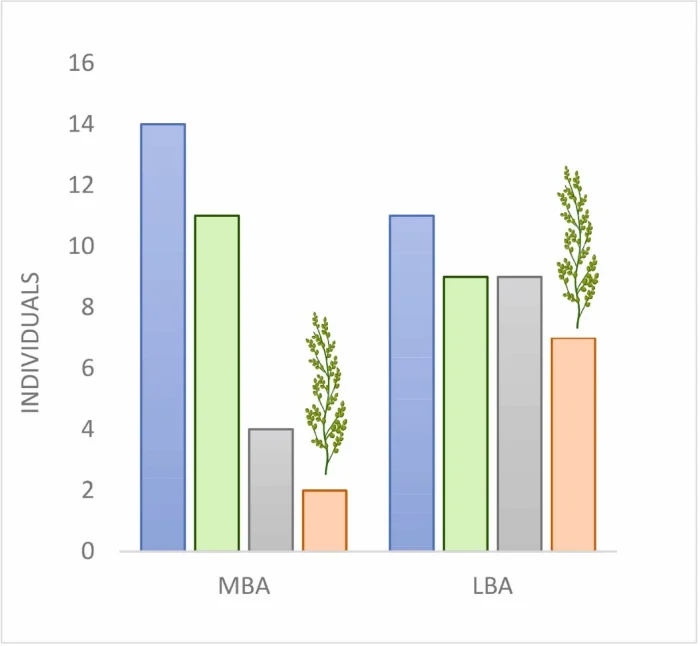
Because food remains are rarely preserved, stable isotope analyses of carbon (δ¹³C) and nitrogen (δ¹⁵N) in human bones and teeth are particularly important for reconstructing past diets. Nitrogen isotope analyses have shown that among prehistoric communities living in western Central Europe, men and individuals belonging to the highest social strata – such as leaders buried in monumental burial mounds – generally consumed more meat than women and children, whose diets consisted primarily of grain-based foods (Kalla et al. 2013; Knipper et al. 2015; Anders 2016; Cavazzuti–Arena 2020; Kiss 2025). Carbon isotope analyses demonstrate that, alongside the consumption of barley and wheat, which are C3 plants that fix carbon dioxide during photosynthesis in the form of three-carbon sugars, millet – an important source of protein and a C4 plant – appeared in the Carpathian Basin from the Black Sea region during the middle of the Bronze Age, in the 16th century BC. Stable isotope analyses of nitrogen in human remains from the Tiszafüred cemetery, combined with microremains identified in dental calculus, indicate that during the Middle Bronze Age, in the period of the Füzesabony culture, people had a more diverse diet, and social differences were more clearly reflected in food consumption, particularly in access to animal protein such as meat and dairy products. By the beginning of the Late Bronze Age, during the Tumulus Culture period, this difference had diminished: people consumed considerably less animal protein than before and supplemented their meals with millet. As a result, the diet became more uniform, but also poorer in nutritional terms (Cavazzuti et al. 2025).
Another analysis, drawing on complex bioanthropological and genetic research, has likewise shown that, compared with the hunter-gatherer groups of the Palaeolithic and Mesolithic, European communities consumed less meat and much more grain after the emergence of food production. This dietary shift negatively affected their overall health and may have contributed to the spread of certain diseases. In a study that also included samples from Hungary, researchers compared stature estimated from bone length – that is, the height people actually attained – with the height they could potentially have reached based on their genetic background. The results suggest that, relative to the stature predicted from genetic data, there was a clear decline in human height during the Neolithic, with average stature decreasing by 3.82 cm. It then began to increase during the Copper Age (+1.95 cm compared with the Neolithic average), followed by further increases in the Bronze Age (+2.7 cm) and Iron Age (+3.27 cm; Marciniak et al. 2022). The high protein content of millet, which appeared in the Late Bronze Age, may have contributed to this positive change alongside the consumption of wheat varieties (einkorn and emmer) and barley. In addition to being used in porridges and baked goods, millet also found its way into beer production, as we will see in the next instalment.
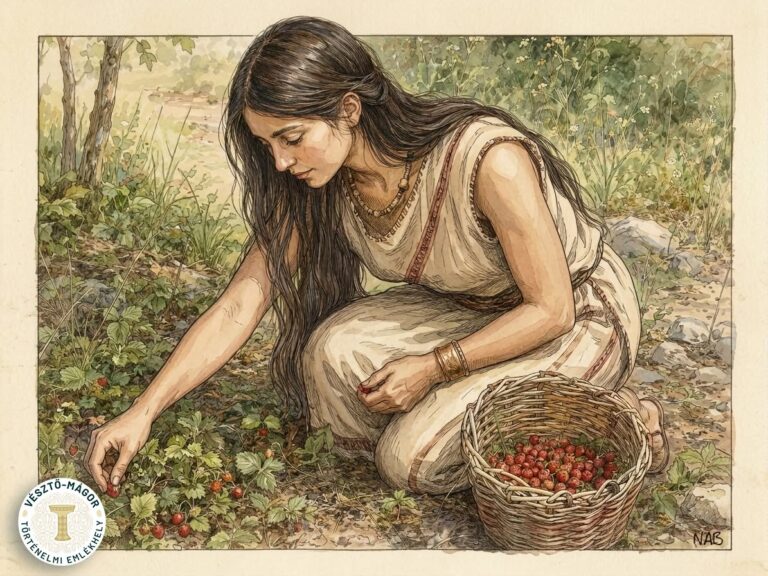
Actual food remains have survived only in a small number of cases, but their analysis has produced particularly interesting results. At the Hallstatt salt mine in Austria, where salt extraction is demonstrably attested from the Bronze Age onwards, scattered food remains and human faeces have provided evidence from which a one-pot dish could be reconstructed. It contained just 5% pork, alongside 41% barley, 27% millet and an equal proportion of field beans (Kowarik et al. 2010; Kalla et al. 2013, 27). Visitors to the Sóstó Open-Air Museum even had the opportunity to taste a reconstruction of this dish. A rare find comes from the Late Bronze Age settlement of Balatonmagyaród-Hídvégpuszta: a charred food remain which, according to the analyses of Ferenc Gyulai, can be identified as a cake made from a mixture of very finely ground wheat and millet flour, with pork fat and wild strawberries, and possibly also the eggs of wild birds and honey (Gyulai 1996). More recently, these studies were also discussed at the Vésztő-Mágor Historical Memorial Site, inspiring one of the visitors to prepare a modern version of the strawberry cake.
Dairy Products
DNA studies have revealed that, despite the emergence of animal husbandry – and even much later, in the 2nd millennium BC – European communities had not yet developed the genetic adaptation for lactose tolerance. In other words, they were unable to digest the sugar (lactose) found in animal milk (Allentoft et al. 2015). Analyses of samples taken from the inner surfaces of ceramic vessels, as well as of milk proteins (β-lactoglobulin) preserved in dental calculus, indicate that people consumed animal milk products in processed and fermented forms, primarily from sheep and goats and, to a lesser extent, from horses and cattle. These included yoghurt and cheese (Charlton et al. 2019; Wilkin et al. 2020).
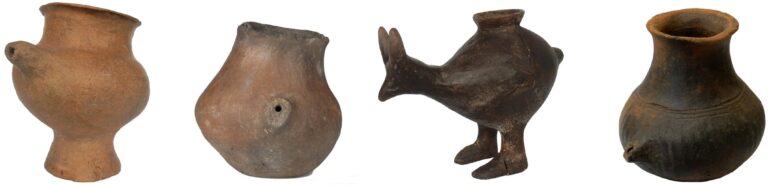
Breastfeeding of children – which generally continued until the age of two or three, and more rarely until four – was supplemented with sheep’s and goat’s milk before the transition to solid foods (Münster et al. 2018). These types of milk are more easily digestible than cow’s milk. This supplementary feeding is proven by analyses of small vessels fitted with narrow spouts or “tubes,” which may have been used for infants’ nutrition (Dunne et al. 2019).
All of this suggests that the grain-rich diet of the first farmers and Bronze Age communities, containing relatively little meat and dairy products alongside gathered fruits, did not differ greatly from the foods consumed in medieval peasant communities. (Naturally, however, plants that arrived in Europe from the New World in the early modern period – such as peppers, tomatoes, potatoes and maize – were unknown.) Alongside everyday meals, communal feasting also played an important role in the Bronze Age, much as it does today. Such feasts may have been held as part of funerary ceremonies, at celebrations associated with the changing seasons and the agricultural cycle, and perhaps also to strengthen alliances among members of the elite (Kalla et al. 2013).
References
Allentoft, M.E., Sikora, M., Sjögren, K.G., Rasmussen, S., Rasmussen, M., Stenderup, J., Damgaard, P.B., Schroeder, H., Ahlström, T., Vinner, L., Malaspinas, A.S., Margaryan, A., Higham, T., Chivall, D., Lynnerup, N., Harvig, L., Baron, J., Della Casa, P., Dąbrowski, P., Duffy, P.R., Ebel, A.V., Epimakhov, A., Frei, K., Furmanek, M., Gralak, T., Gromov, A., Gronkiewicz, S., Grupe, G., Hajdu, T., Jarysz, R., Khartanovich, V., Khokhlov, A., Kiss, V., Kolář, J., Kriiska, A., Lasak, I., Longhi, C., McGlynn, G., Merkevicius, A., Merkyte, I., Metspalu, M., Mkrtchyan, R., Moiseyev, V., Paja, L., Pálfi, G., Pokutta, D., Pospieszny, Ł., Price, T.D., Saag, L., Sablin, M., Shishlina, N., Smrčka, V., Soenov, V.I., Szeverényi, V., Tóth, G., Trifanova, S.V., Varul, L., Vicze, M., Yepiskoposyan, L., Zhitenev, V., Orlando, L. Sicheritz-Pontén, T., Brunak, S., Nielsen, R., Kristiansen, K., Willerslev, E.: Population genomics of Bronze Age Eurasia. Nature 522 (2015) 167–172.
Anders A.: Csontváztól az emberig. Neolitikus temetkezések kutatásának újabb eredményei Polgár környékén I. Magyar Régészet 2016 Nyár, 1–5.
Cavazzuti, C., Arena, A.: The Bioarchaeology of Social Stratification in Bronze Age Italy. Archeo 37 (2020) 69–105.
Cavazzuti, C., Horváth, A., Gémes, A., Fülöp, K., Szeniczey, T., Gamarra Rubio, B., Vicze, M., Bárány, A., Pető, Á., Magyari, E., K., Darabos, G., Futó, I., Molnár, M., Lisztes-Szabó, Zs., Molnár, E., Novak, M., Gál, E. P. P. Fischl, K., Kulcsár, G., Szeverényi, V., Szabó, G., Mester, E., Dani, D., Palcsu, L., Kiss, V., Major, I., Hajdu, T.: Multi-isotope, dental calculus and archaeobotanical analyses reveal significant cultural changes and introduction of systematic millet consumption around 1500 BCE in Eastern-Central Europe. Scientific Reports 15 (2025) 17494. DOI: https://doi.org/10.1038/s41598-025-01113-z
Charlton, S., Ramsøe, A., Collins, M., Craig, O. E., Fischer, R., Alexander, M., Speller, C. F.: New insights into Neolithic milk consumption through proteomic analysis of dental calculus. Anthropological and Archaeological Sciences 11 (2019) 6183–6196.
Dunne, J., Rebay-Salisbury, K., Salisbury, R.B. et al.: Milk of ruminants in ceramic baby bottles from prehistoric child graves. Nature 574 (2019) 246–248.
Gyulai F.: Balatonmagyaród–Hídvégpuszta késő bronzkori település növényleletei és élelmiszermaradványai. Zalai Múzeum 6 (1996) 169–196.
Kalla G., Raczky P., V. Szabó G.: Ünnep és lakoma a régészetben és az írásos forrásokban. Az őskori Európa és Mezopotámia példái alapján. In: Déri B. (szerk.): Convivium. Az Eötvös Loránd Tudományegyetem Bölcsészettudományi karán 2012. november 6–7-én tartott vallástudományi konferencia előadásai. Antion könyvek 2. Budapest 2013, 11– 46.
Kiss V.: Bronzkori élettörténetek Magyarországon (Kr. e. 3–2. évezred). Hereditas Archaeologica Hungariae 5. Budapest 2025.
Knipper, C., Fragata, M., Nicklisch, N., Siebert, A., Szécsényi-Nagy, A., Hubensack, V., Metzner-Nebelsick, C., Meller, H., Kurt, W.A.: A Distinct Section of the Early Bronze Age Society? Stable Isotope Investigations of Burials in Settlement Pits and Multiple Inhumations of the Únětice Culture in Central Germany. American Journal of Physical Anthropology 159 (2015) 496–516.
Kowarik, K., Reschreiter, H. & Wurzer, G.: Modeling a mine. Agentbased Modeling, Systemdynamics and Experimental Archaeology applied to the Bronze Age Saltmines of Hallstatt. In: Holzner, B. & Tilmann, M. (eds.): Mining in European History. Spezialforschungsbereich HiMAT. Innsbruck 2010, 44–53.
Marciniak, S., Bergey, Ch. M., Silva, A. M., Hałuszko, A., Furmanek, M. Veselka, B., Velemínsky, P., Vercellotti, G., Wahl, J., Zarina, G., Longhi, Ch., Kolár, J., Garrido-Pena, R., Flores-Fernandes, R., Herrero-Corral, A. M., Simalcsik, A., Müller, W., Sheridan, A., Miliauskiené, Ž., Jankauskas, R., Moiseyev, V., Köhler, K., Király, Á., Gamarra, B., Cheronet, O., Szeverényi, V., Kiss, V., Szeniczey, T., Kiss, K., K. Zoffmann, Zs., Koós, J., Hellebrandt, M., Maier, R. M.,Domboróczky, L., Virag, C., Novak, M., Reich, D., Hajdu, T., von Cramon-Taubadel, N., Pinhasi, R., Perry, G.H.: An integrative skeletal and paleogenomic analysis of stature variation suggests relatively reduced health for early European farmers. PNAS 119 (2022) 1–12. https://doi.org/10.1073/pnas.2106743119
Münster, A., Knipper, C., Oelze, V. M., Nicklisch, N., Stecher, M., Schlenker, B., Ganslmeier, R., Fragata, M., Friederich, S., Dresely, V., Hubensack, V., Brandt, G., Döhle, H.-J., Vach, W., Schwarz, R., Metzner-Nebelsick, C., Meller, H., Alt, K. W.: 4000 years of human dietary evolution in central Germany, from the first farmers to the first elites. PlosOne 13 (2018) e0194862
Wilkin, S., Miller, A. V., Taylor, W. T., Miller, B. K., Hagan, R., W., Bleasdale, M., Scott, A., Gankhuyg, S., Ramsøe, A., Uliziibayar, S., Trachsel, C., Nanni, P., Grossmann, J., Orlando, L., Horton, M., Stockhammer, P. W., Myagmar, E., Boivin, N., Warinner, C., Hendy, J.: Dairy pastoralism sustained Eastern Eurasian steppe populations for 5000 years. Nature Ecology & Evolution 4 (2020) 346–355.