Tastes of the past in the Bronze Age. Alcoholic beverages
Beer brewing from barley dates to a surprisingly distant past, as the earliest evidence comes from the Raqefet Cave in Israel, a site associated with the Natufian culture dating to around 13,000 years ago. From the 5th to the 4th millennium BC onwards, information regarding the brewing and consumption of beer becomes increasingly abundant (Liu et al. 2018; Trifonov et al. 2022). Later Sumerian and Egyptian written sources shed light on the details of beer production and its flavouring with dates and spices, as well as the important role it played in people’s lives. As we read in the Epic of Gilgamesh, for Enkidu, the ‘primitive man’, the consumption of beer and bread was synonymous with civilisation (Gál 1988; George 2003).
‘No one had taught him
how to eat bread,
he did not know
how to drink beer.’
Beer and mead in the Bronze Age
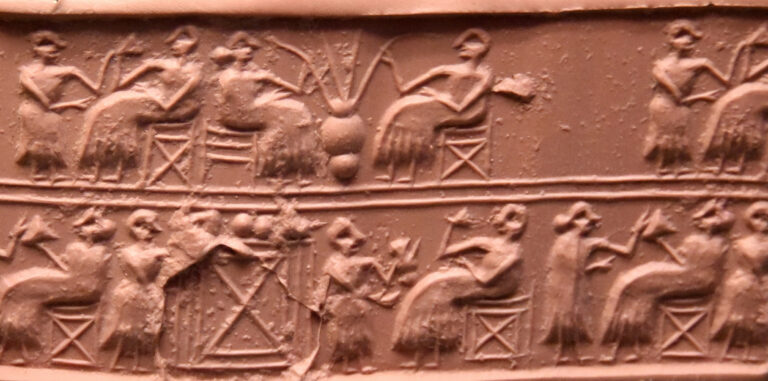
This ancient beer was fundamentally different from most beers consumed today: it was a thick, unfiltered drink, with grain husks and spelt residues floating on the surface. In the royal tombs at Ur in Iraq, among the grave goods from the tomb of Queen Puabi buried around 2450 BC, metal covers made from gold and silver strips were unearthed, together with depictions on cylinders seals found at the same site, suggesting that the elite consumed this unfiltered beer at communal feasts using long reed straws fitted with precious-metal covers. Similar precious-metal tubes were discovered in the Majkop kurgan, dated to 3300 BC, alongside barley starch granules and grain phytoliths, suggesting that the Sumerians’ feasting culture was also known amongst the population of the Caucasus (Trifonov et al. 2022).
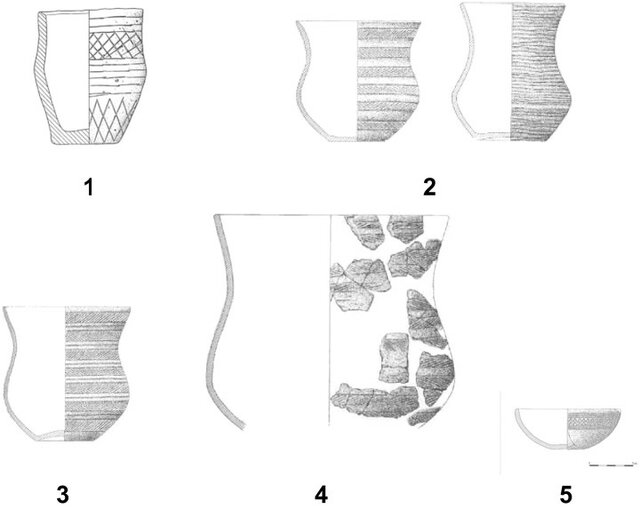
In European lakeside settlements dating from the 4th millennium BC, thanks to the oxygen-deprived conditions created by the waterlogging, grain seeds with thinned or degraded cell walls have been discovered. These findings suggest the production of malt made from germinated wheat or barley, and thus potentially the production of beer (Heiss et al. 2020). Bell Beaker vessels were widespread across large parts of Europe; previous research has already linked them to beer-drinking (Sherratt 1997; Turek 2020). Archaeobotanical, phytolith and chemical analyses have confirmed the presence of beer in several vessels from this period. At the Ashgrove Farm site in Scotland, pollens from small-leaved lime (Tilia cordata) and meadowsweet (Filipendula ulmaria) suggest the consumption of mead, produced by fermenting honey and water (Guerra-Doce 2006).
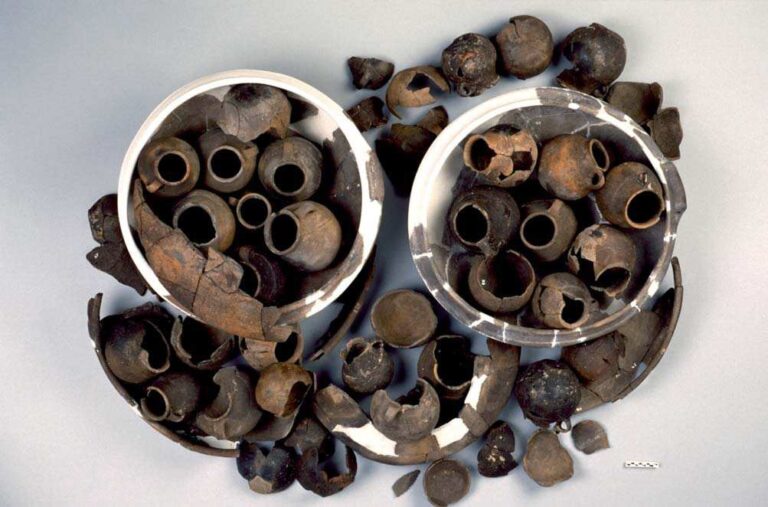
No similar findings have yet been reported from Bell Beaker the archaeological material in Hungary. In the Carpathian Basin, for example in the Lake Fertő region and the Mureș region, however, assemblages of small, handled vessels – so-called ‘mug hoards’ – are known in which the vessels were sometimes placed in bowls or buried in the ground with their handles bound together. On this basis, archaeological research concludes that drinks consumed in company may also have formed part of Early Bronze Age feasts in this region (P. Fischl et al. 1999, 93-96; Krenn-Leeb 2010).
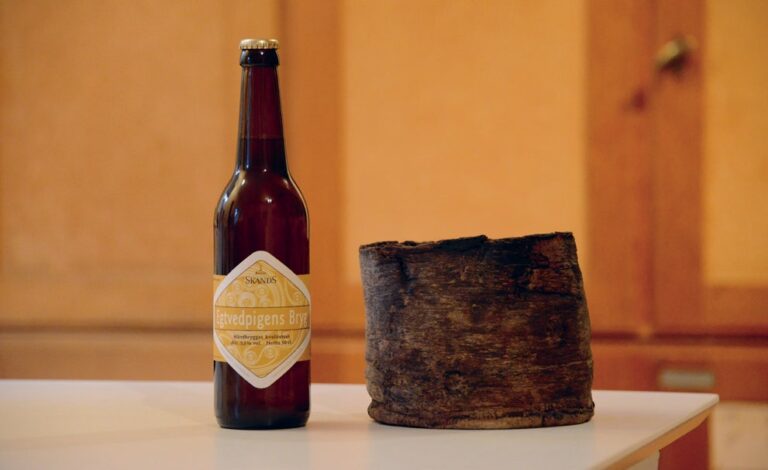
The beers mentioned were darker in colour, sweeter and more similar to modern ales than to lagers. In ales, the yeast settles on top of the beer at the end of the process (so-called top or warm fermentation, taking place at temperatures between 16 and 25 °C). Today, the lighter, lager-type beers are more common (containing hops as an additive and brewed at lower temperatures of 6–10 °C, a process known as ‘bottom fermentation’). Traces of such an ale-type beverage were found in the grave of the Egtved Girl, buried around 1350 BC, during the analysis of a birch-bark vessel placed at her feet. This beverage was brewed from malted grain, berries (blueberries or cranberries) and honey, flavoured with additional plant-based ingredients (e.g. white myrtle; (Hald et al. 2016). Some authors use the term ‘grog’ for such mixed alcoholic drinks (McGovern et al. 2013; Tarbay 2014). In its later historical use, however, the term came to refer primarily to a mixture of water and alcohol (especially rum), associated with European naval and maritime practice, which was flavoured with honey and spices, and later with lemon as well.
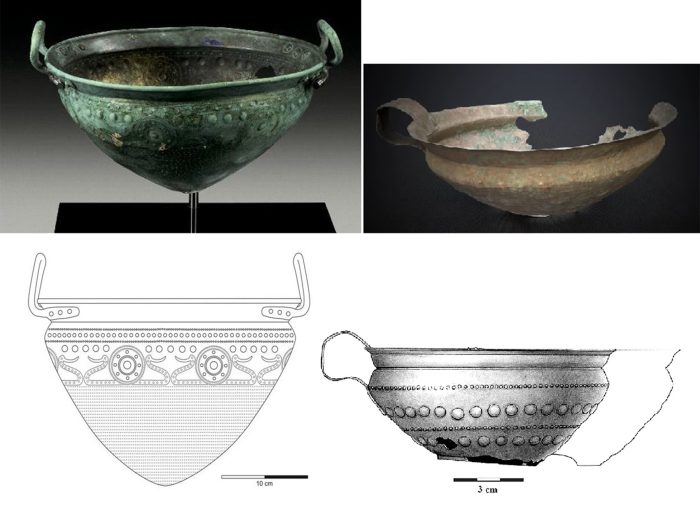
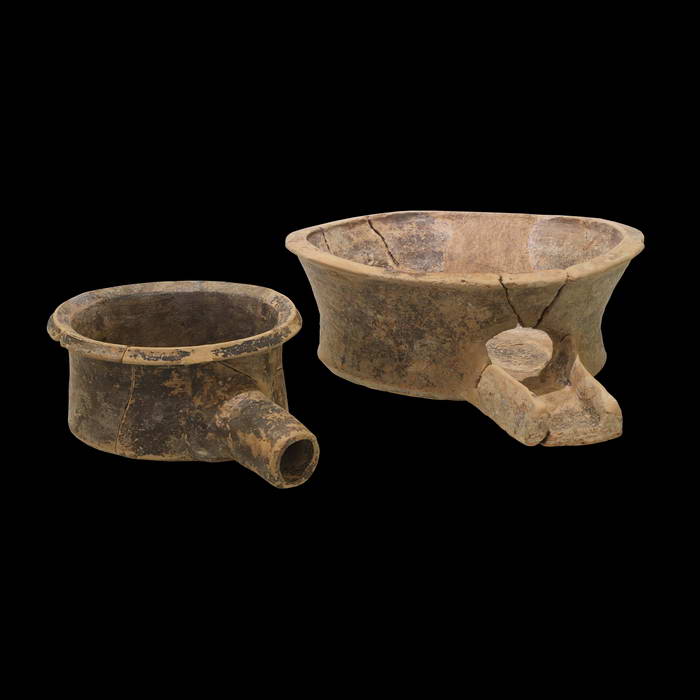
In a metal vessel dating from the 9th century BC – typical of the end of the Bronze Age – residues of a drink made with wild yeast and wormwood, also containing millet, have been found near Kladina in Czechia (Jílek et al. 2022). This drink, recreated at the University of Olomouc’s brewery, has been compared with Belgian (lambic) beers; it has an aroma reminiscent of cider, whilst its flavour has hints of lemon. The existence of a similar drinking culture is suggested by the Late Bronze Age pottery banquet sets found in the Carpathian Basin, typically comprising 20–30 high-quality, thin-walled cups, the same number of bowls with sculpted decoration, and a few larger storage and serving vessels. This is further indicated by assemblages consisting of bronze buckets, cups and straining vessels dating from the 10th century BC (Kalla et al. 2013, 24-25; Tarbay 2014). Only a few compositional analyses have been carried out in Hungary; it is therefore significant that the remains of a Kirkendrup–Jenišovice-type bronze cup of similar age, unearthed on Somló Hill, have recently been found to contain traces of a millet-based drink and honey – or possibly honey-flavoured porridge – which may be related to the remains found at Kladina (Tarbay et al. 2025).
Was wine the drink of the Bronze Age elite?
The dating of the emergence of wine made from domesticated grapevines (Vitis vinifera) was previously uncertain, as the presence of grape seeds does not necessarily indicate the production or consumption of wine. Today, biomolecular analyses can detect chemical markers associated with winemaking: this has made it possible to identify the earliest vessels used for storing wine, dating back 8,000 years, in what is now Georgia (McGovern et al. 2017). The earliest known wine-production and storage facility, dating to 4300–3400 BC, was excavated in Armenia. Further evidence from the 4th millennium BC has been found in Cyprus and Iran (Harutyunya–Malfeito-Ferreira 2022). Numerous records and sources from Mesopotamia, Egypt and the Aegean region attest to the consumption of wine made from grapes – primarily by the elite – during the 3rd and 2nd millennia BC (Gál 1988; Kalla et al. 2013, 35). Evidence for wine storage in pithoi and finds suggesting the existence of wine presses dates back to the Early Bronze Age on Crete and to the Late Bronze Age Mycenaean palaces respectively. Furthermore, Linear B texts describing trade between the palaces add to our knowledge of the subject (Valamoti et al. 2019; Harutyunya–Malfeito-Ferreira 2022).
According to written sources, wine was generally drunk mixed with water and flavoured with spices, as Greek texts describe the consumption of wine on its own as a barbaric custom. Usually, two or three parts water were mixed with one part wine; the mixture was measured out from the mixing vessel, the krater, and drunk from a footed cup, the kylix. Analysis of acidic deposits in drinking vessels unearthed from the layers of Troy, which indicate wine produced by the fermentation of grapes, provides evidence that implements associated with wine consumption are found not only in the citadel but throughout the entire city from the 3rd millennium BC, that is, from the Early Bronze Age in the region. On this basis, researchers in the region conclude that wine in Troy was not merely the drink of the elite (Blum et al. 2025).
In the area occupied by the Terramare culture in northern Italy, evidence of winemaking dates to around 1600–1500 BC: macrobotanical remains of grapevines, traces of sulphur dioxide and resinous products derived from plants belonging to the pine family (Pinaceae) – that is, perhaps similar to modern-day retsina (Harutyunya–Malfeito-Ferreira 2022; Pecci et al. 2020). Given the close links with the Po Valley, it can only be surmised at this stage that, at the beginning of the Late Bronze Age, an alcoholic drink made from wine grapes may also have been known in the Carpathian Basin. Analysis of Scandinavian metal vessels dating from the 10th century BC, which were in use during the Late Bronze Age and have links to the Carpathian Basin, suggests that a drink made from wine grapes – which could not readily be cultivated in Northern Europe – may have been imported from that region. The sets of bronze vessels mentioned can undoubtedly be linked to the elite (Kalla et al. 2013; Tarbay 2014).
According to written sources from Mesopotamia and Egypt, the often inadequate quality of water was also a reason for consuming alcoholic beverages. Furthermore, as we have seen, these beverages may have played a significant role in rituals on the territory of present-day Hungary, as indicated by the deposition of Early Bronze Age mugs, and Late Bronze Age ceramic hoards, some comprising as many as a hundred vessels. A detailed analysis of the contents of these vessels may later provide important information about the drinking culture of the regions in question.
References
Blum, S. W. E., Rageot, M., Mühlenbruch, T.: The Question of Wine Consumption in Early Bronze Age Troy: Organic Residue Analysis and the Depas amphikypellon. American Journal of Archaeology 129 (2025) 263–279. https://doi.org/10.1086/734061
P. Fischl K., Kiss V., Kulcsár G.: Kora és középső bronzkori település Baks-Homokbánya (Csongrád megye) lelőhelyen – Früh- und mittelbronzezeitliche Siedlungen auf dem Fundort Baks-Homokbánya (Komitat Csongrád). MFMÉ–Studia Archaeologica 5 (1999) 77–190.
Gál E.: A sör Egyiptomban és Mezopotámiában. Budapest 1988.
George, A. R., The Babylonian Gilgamesh Epic. Oxford University Press, 2003.
Guerra-Doce, E.: Exploring the significance of beaker pottery through residue analyses. Oxford Journal of Archaeology 25 (2006) 247–259.
Hald, M.M., Henriksen, P.S., Mortensen, M.F.: Food, economy and society: Multi-faceted lessons tolearn from ancient plant remains. In: Jørgensen, L., Lynnerup, N., Løkke, A., Balslev, H. (eds): Food, Population and Health – global Patterns and Challenges. Proceedings of an Interdisciplinary Symposium on the Dynamics from Prehistory to Present. Copenhagen 2016, 169–178.
Harutyunya, M., Malfeito-Ferreira, M.: The Rise of Wine among Ancient Civilizations across the Mediterranean Basin. Heritage 5 (2022) 788–812.
Heiss, A. G., Azorín, MB, Antolín, F., Kubiak-Martens, L., Marinova, E., Arendt, E. K., Biliaderis, C. G., Kretschmer, H., Lazaridou, A., Stika, H. P., Zamkow, M., Bab, M., Belicher, N., Cialowich, K. M., Chlodnicki, M, Matuschik, M., Schlichterle, H., Valamoti, S. M.: Mashes to Mashes, Crust to Crust. Presenting a novel microstructural marker for malting in the archaeological record. PLoS ONE 15 (2020) e0231696. https://doi.org/10.1371/journal.pone.0231696
Jílek, J., Golec, M., Bednář, P., Chytráček, M., Vích, D., Zavoral, T., Mírová, Z., Petr, L., Kovárník, J., Milo, P., Kučera, L.: The oldest millet herbal beer in the Europe? The ninth century BCE bronze luxury bucket from Kladina, Czech Republic. Archaeometry 64 (2022) 454–467. https://doi.org/10.1111/arcm.12711
Kalla G., Raczky P., V. Szabó G.: Ünnep és lakoma a régészetben és az írásos forrásokban. Az őskori Európa és Mezopotámia példái alapján. In: Déri B. (szerk.): Convivium. Az Eötvös Loránd Tudományegyetem Bölcsészettudományi karán 2012. november 6–7-én tartott vallástudományi konferencia előadásai. Antion könyvek 2. Budapest 2013, 11– 46.
Krenn-Leeb, A.: Ressource versus Ritual – Deponierungsstrategien der Frühbronzezeit in Österreich. In: Meller, H., Bertemes, F. (Hrsg.): Der Griff nach den Sternen. Internationales Symposium in Halle (Saale) 16.–21. Februar 2005. Tagungen des Landesmuseums für Vorgeschichte Halle 5. Halle (Saale) 2010, 281–315.
Liu, L,, Wang, J.,Rosenberg, D., Zhao, H., Lengyel, Gy., Nadel, D.: Fermented beverage and food storage in 13,000 y-old stone mortars at Raqefet Cave, Israel: Investigating Natufian ritual feasting. Journal of Archaeological Science: Reports 21 (2018) 783–793. https://doi.org/10.1016/j.jasrep.2018.08.008.
McGovern, P. E., Halla, G. E.,, Mirzoian, A.: A biomolecular archaeological approach to ‘Nordicgrog’. Danish Journal of Archaeology (2013) https://doi.org/10.1080/21662282.2013.867101
McGovern, P., Jalabadze, M., Batiuk, S., Callahan, M. P., Smith, K. E., Hall, G. R., Kvavadze, E., Maghradze, D., Rusishvili, N., Bouby, L., Failla, O., Cola, G., Mariani, L., Boaretto, E., Bacilieri, R., This, P., Wales, N., Lordkipanidze, D.: Early Neolithic wine of Georgia in the South Caucasus. PNAS 114 (2017) E10309-E10318.
Pecci, A., Borgna, E., Mileto, S., Dalla Longa, E., Bosi, G., Florenzano, A., Mercuri, A. M., Corazza, S., Marchesini, M., Vidale, M.: Wine consumption in Bronze Age Italy: combining organic residue analysis, botanical data and ceramic variability. Journal of Archaeological Science 123 (2020) 105256.
Sherratt, A.: Cups that Cheered: The Introducion of Alcohol to Prehistoric Europe. In: Sherratt, A. (eds): Economy and Society in Prehistoric Europe. Changing Perspectives. Edinburgh 1997, 377–402.
Tarbay J. G.: Grog a bronzkori kárpát-medencében? Gondolatok a késő bronzkor italozási kultúrájáról egy egyedülálló szűrőedény kapcsán. Magyar Régészet 2014 Nyár 1–9.
Tarbay, J. G., Soós, B., Péterváry, T., Pető, Á., Kósa, P., Szabó, G., Czirok, I. S., Czégény, Zs.: Millet and honey in a Late Bronze Age Kirkendrup–Jenišovice-type bronze cup from the Somló Hill. Archaeologiai Értesítő 150 (2025) 105–117. https://doi.org/10.1556/0208.2025.00097
Turek, J.: Beer, Pottery, Society and Early European Identity. Archaeologies: Journal of the World Archaeological Congress 16 (2020) 396–423. https://doi.org/10.1007/s11759-020-09406-7 2020
Trifonov, V., Petrov, D., Savelieva, L. 2022: Party like a Sumerian: reinterpreting the ‘sceptres’ from the Maikop kurgan. Antiquity 96 (2022) 67-84. https://doi.org/10.15184/aqy.2021.22
Valamoti, S. M., Pagnoux, C., Ntinou, M., Bouby, L., Bonhomme, V., Terral, J.-F.: More than meets the eye: new archaeobotanical evidence on Bronze Age viticulture and wine making in the Peloponnese, Greece. Vegetation History and Archaeobotany 2019 https://doi.org/10.1007/s00334-019-00733-6