FORCES – Forging Communities, Emerging Power: A New National Research Excellence STARTING Project Led by Eszter Melis
In 2026, the FORCES – Forging Communities, Emerging Power: Social Dynamics in Bronze Age Northwestern Carpathian Basin between 2200 and 1400 BC project was launched at the Institute of Archaeology, ELTE Research Centre for the Humanities, with Eszter Melis as Principal Investigator. Supported by the NRDI Office National Research Excellence STARTING programme, this four-year research project investigates how communities were forged during the first half of the Bronze Age, how social inequalities emerged, and how new forms of power and control developed in the northwestern Carpathian Basin.
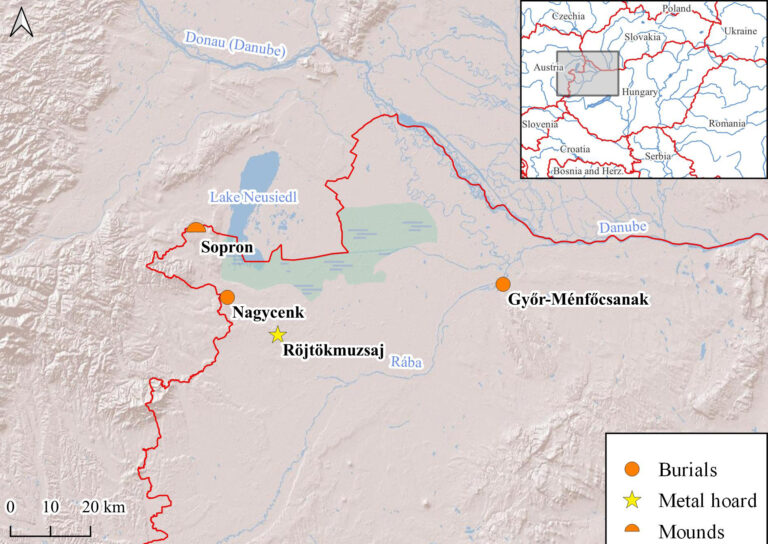
The study area of the FORCES project (map by Eszter Melis)
The project focuses on the region between Lake Fertő (Neusiedler See) and the River Rába in Hungary, with particular emphasis on the Bronze Age cemeteries of Nagycenk and Ménfőcsanak. This region formed an important gateway towards the western parts of Central Europe and provides an ideal archaeological context for investigating how long-distance contacts, the circulation of copper and other raw materials, and technological innovations influenced the development of local communities.
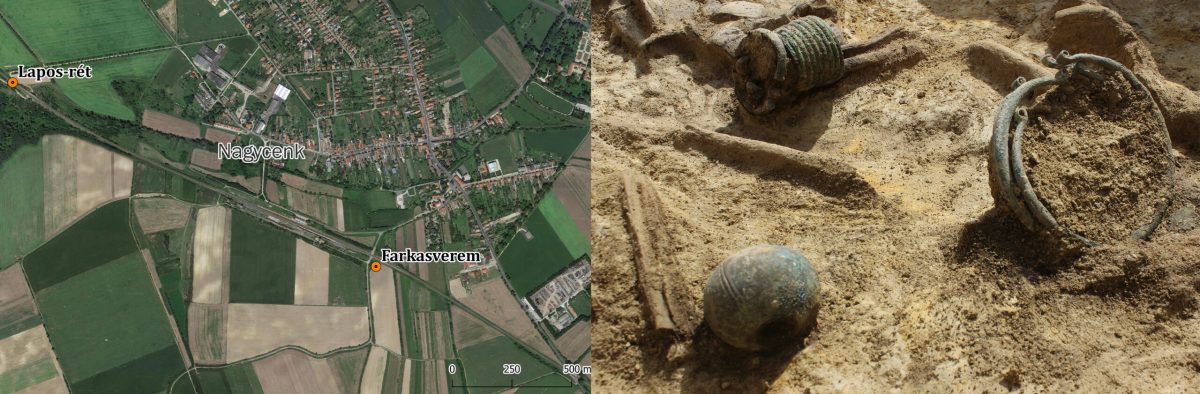
Location of the Nagycenk-Lapos-rét and Nagycenk-Farkasverem sites, together with the mace head, neck rings and arm rings from Grave S153 at Nagycenk-Farkasverem (map by Eszter Melis; photo by Gábor Szalai, Rómer Flóris Museum of Art and History)
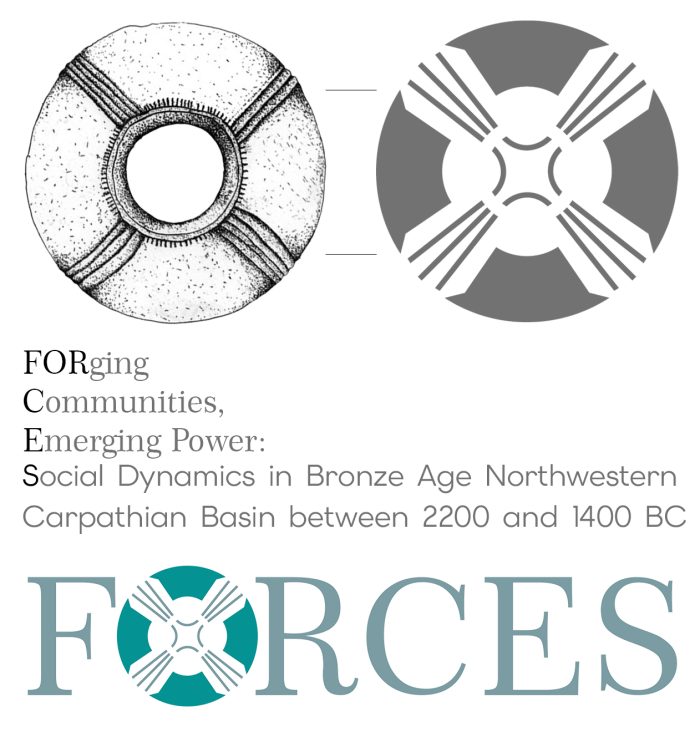
The exceptional importance of the Nagycenk area lies in two cemeteries belonging to the Gáta–Wieselburg Culture. The graves yielded numerous copper and bronze artefacts, including a unique bronze-covered stone mace head, which most likely served as a symbol of power associated with a high-status individual. This remarkable object also inspired the project’s logo: the mace head represents power, control, and the social dynamics that shaped Bronze Age communities.
The acronym FORCES derives from the English project title while also referring to the multiple meanings of the word forces: not only physical force, but also the social forces that influenced community formation, social relations, and the emergence of power.
Elements of the FORCES project logo (drawing by Attila Mrenka, Sopron Museum; graphic design by Zsóka Varga, Institute of Archaeology, ELTE Research Centre for the Humanities)
The first half of the Bronze Age (2200–1400 BC) was one of the most transformative periods in European prehistory. Bronze—the alloy of copper and tin—not only created new technological opportunities but also connected distant regions through extensive exchange networks. The possession of rare and valuable metal objects increasingly became a visible expression of social status and power. The FORCES project investigates how these changes can be understood through their archaeological contexts, especially burial practices and material culture.
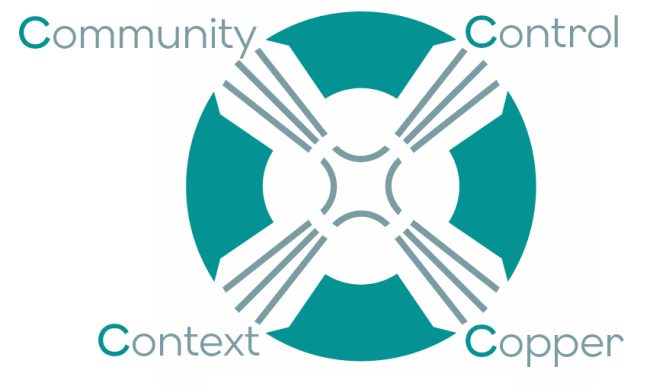
The FORCES project logo and the thematic groups of the project (logo design by Zsóka Varga, Institute of Archaeology, ELTE Research Centre for the Humanities)
The central questions of the FORCES project concern how Bronze Age communities were forged and how systems of power and control emerged. Were social differences primarily rooted in kinship relationships, or were they determined by access to economic resources and positions of authority? The project’s results will contribute to a better understanding of the emergence of increasingly complex social systems in Bronze Age communities of the Carpathian Basin.
A key feature of the project is the integration of archaeological and scientific methods. Researchers will analyse the context of burials, grave goods, and human remains in detail. Radiocarbon dating will refine the chronological framework, archaeogenomic analyses will investigate biological kinship and population history, while stable isotope analyses will provide new insights into the diet, mobility, and lifeways of Bronze Age individuals.
The project also follows the pathways of copper. By investigating the composition and provenance of copper and bronze artefacts, it seeks to reconstruct the exchange networks through which raw materials and finished objects reached Bronze Age communities and to explore how the control of these resources contributed to social differentiation.
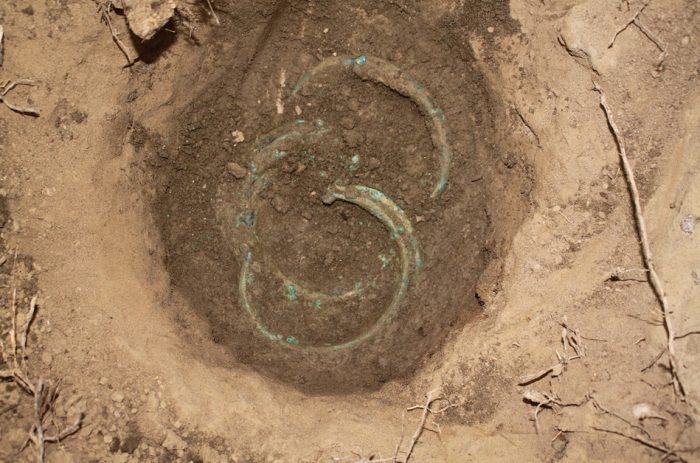
Copper neck-ring depot from the outskirts of Röjtökmuzsaj (Mrenka 2023, Fig. 5)
In addition, the project investigates Bronze Age burial mounds and their surrounding landscapes in the Sopron region using modern, non-invasive methods, including airborne laser scanning (LiDAR), geophysical survey, and GIS-based spatial analyses.
The long-term objective of the FORCES project is to provide new archaeological data and innovative analytical approaches for understanding how Bronze Age societies functioned. By integrating archaeological context with cutting-edge scientific methods, the project seeks to reveal how communities were forged, how control over people and resources developed, and how power emerged in the northwestern Carpathian Basin during the 2nd millennium BC.