The Town Shaped by Rivers: Lecture and Archaeological Walk Through Prehistoric Győr
Researchers’ Nightis an annual pan-European event held on the last weekend of September, dedicated to showcasing the diverse work of researchers and innovators. As part of this initiative, Eszter Melis from our research team co-organized an event in Győr on September 25, 2026, in collaboration with the Rómer Flóris Museum of Art and History. Together with Ferenc Ujvári, an archaeologist specializing in the Iron Age at the museum, they set out to trace the prehistoric heritage of Győr through a joint presentation and a guided archaeological walking tour. Where could human communities settle in the “city of rivers”? The present and former channels of the Danube (Moson branch), the Rába, and the Rábca rivers, along with once-extensive wetlands, fundamentally determined where long-term human habitation was possible.
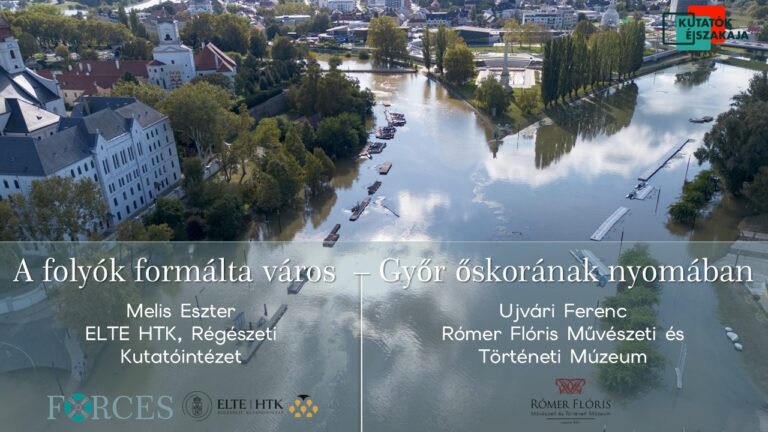
Opening slide of the presentation, featuring a photo of the September 2024 flood at the confluence of the Rába River
For prehistoric humans, elevated terrain protected from floods and groundwater was especially valuable, rising like islands above the waterlogged landscape. One such key site is Káptalandomb (Chapter Hill) in Győr and its surrounding downtown area, where evidence of human presence spans multiple prehistoric periods.
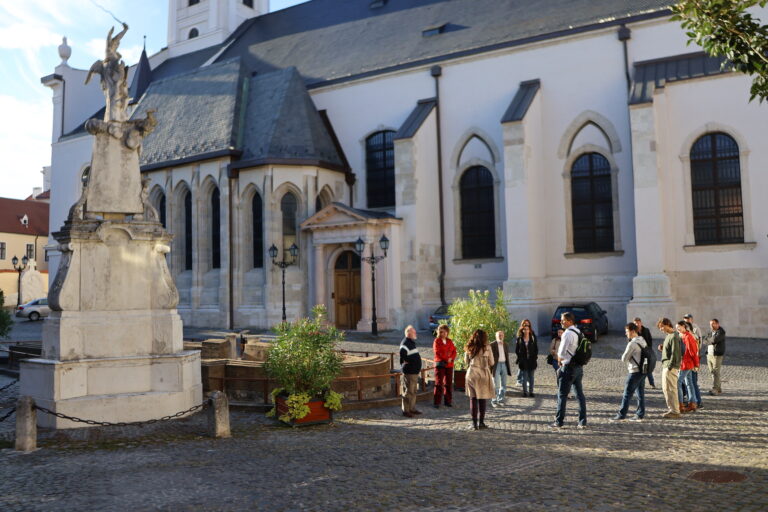
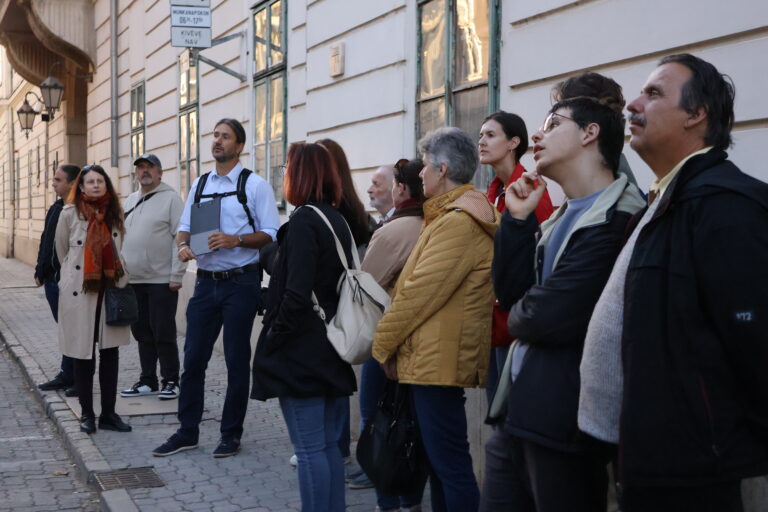
The first stop of the walking tour at Káptalandomb (Photo: Zsuzsanna Szabadvári-Farkas, Rómer Flóris Museum of Art and History)
Through artifacts and sites from the Neolithic, Bronze, and Iron Ages, Eszter Melis and Ferenc Ujvári illustrated how ancient communities lived and adapted to their environment in what is now Győr, while rivers and wetlands continuously reshaped the surrounding landscape. The event was based on a comprehensive archaeological chapter published in the city monograph History of Győr I., co-authored by the speakers alongside Szilvia Bíró, Attila Molnár, and Péter Tomka (Bíró et al. 2021).
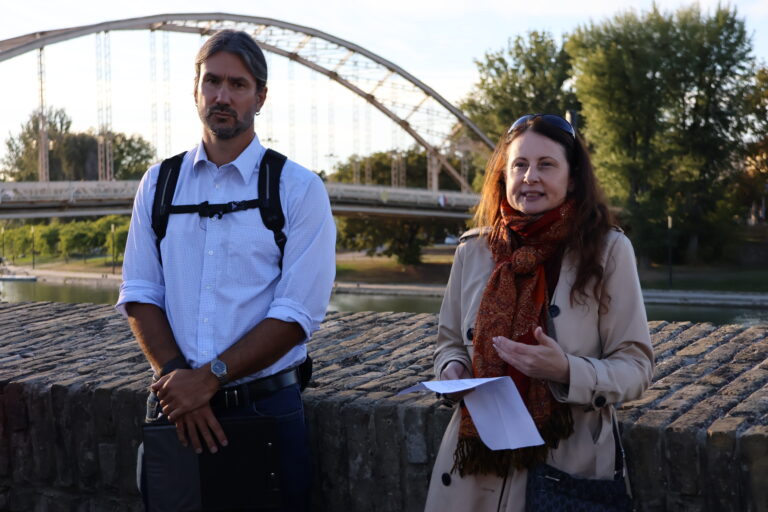
Lecture near the Moson Danube (Photo: Zsuzsanna Szabadvári-Farkas, Rómer Flóris Museum of Art and History)
During the tour, the guide covered not only the sites of prehistoric settlements and burials but also highlighted how traces of the multi-millennial landscape—where prehistoric communities once thrived—can still be read in the layout of the modern town today.
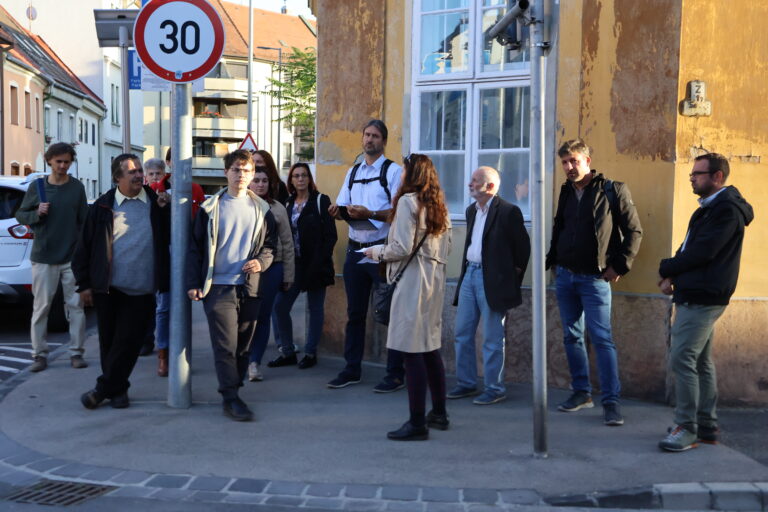
At the corner of Újkapu and Rákóczi Ferenc Streets, near a Late Bronze Age and Iron Age settlement site (Photo: Zsuzsanna Szabadvári-Farkas, Rómer Flóris Museum of Art and History)
The lecture took place in the grand hall of the Apátúr House, provided by the museum, followed by a 45-minute walking tour through the downtown. The two-hour program drew significant public interest, with many participants staying until the very end.
In front of the Zichy Palace – once potentially the site of a Celtic cemetery (Photo: Zsuzsanna Szabadvári-Farkas, Rómer Flóris Museum of Art and History)
We would like to express our gratitude to everyone who attended the program! Special thanks go to the staff of the Rómer Flóris Museum of Art and History, particularly Dávid Czigány, for making this program possible. We also extend our thanks to the ELTE RCH communicationsteam for promoting the event.
Bíró, Sz.–Melis, E.–Molnár, A.–Tomka, P.–Ujvári, F. 2021: Győr területének története az államalapításig [The history of Győr up to the foundation of the Hungarian state]. In: Horváth, R. (szerk.): Győr története 1. A kezdetektől 1447-ig. Győr 2021, 13–46.